
In one line: a loss limit is a brake, not a budget. Write down the outcome you can't accept, split it into monthly, weekly and daily caps, decide what happens at each line and how you get back, then hand the switch to a machine.
Lesson 14 of the 30-part Trading Decisions course. By Eliza.
Lesson map
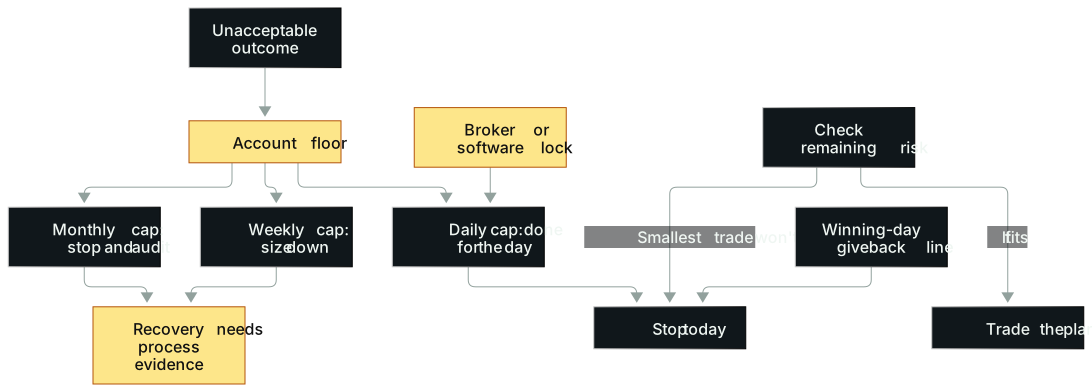
In words: (1) Write down the result you could not live with if things go wrong; that sets your account floor. (2) Split the floor into three layers: hit the monthly cap and you stop to audit the cause, hit the weekly cap and you cut size a notch, hit the daily cap and you are done for the day. (3) The daily switch belongs to your broker or your software, not your willpower. (4) Before each trade, check the risk you have left: if the smallest sensible trade doesn't fit, stop; if it does, trade the plan. (5) Winning days get their own giveback line, and reaching it also ends the day. (6) After a weekly or monthly breach, size comes back on process evidence, not on whether you made the money back.
Opening: down $800, not $4,000
The futures trader from Lesson 4 spent a long stretch of his career on a loop. Several sharp weeks, then a day or two that handed it all back, and more than once an account taken to zero. He described it plainly: there's something in him he can't manage. Most days it sleeps. Lose enough and it wakes up.
The turning point wasn't that he became a calmer person. He moved to a broker that let traders set a personal daily risk lock. Hit the number and the account froze for the rest of the day. No appeals.
Then it woke up again. He did what he always did: added size, chased, went for the one trade that would fix everything. The lock tripped and the order ticket went dead. After the close he did the math. He was down $800. On his old script, a day like that usually ended somewhere near $4,000.
The $3,200 between those two numbers is what one line saved him on the day he needed it most.
He never claimed to be cured. The thing still wakes up; there's just a board across the door now, nailed up while he was clear-headed, for the version of himself that isn't.
This lesson is about building that board: how many layers, how high, who holds the lock, and when it comes down.
The idea
A brake line, not a spending budget
Plenty of traders read a daily limit as "what I'm allowed to lose today." Read it as a budget and you'll want to spend it, one more trade at a time.
Think of it as a brake line instead. In a good week you're nowhere near it. The whole point of having it is that you almost never touch it.
So what is it protecting you from? Spread. One loss is usually survivable. What isn't survivable is what follows it: you want it back, so you size up; that's wrong too, so you widen the stop; still wrong, so you drop the stop entirely. A single bad decision rarely ends a career. The second and third ones stacked on top do. The limit's job is to pull you off the field after the first bad decision and before the second.
Three layers, three kinds of trouble
A daily limit alone isn't enough, because trouble moves at three speeds.
- The daily cap handles loss of control within a day. A string of mistakes, tilt, a platform freezing. Hit it and no new orders today.
- The weekly cap handles things that build over several days. More rule breaks, weaker and weaker setups, a strategy that doesn't fit the current market. No single day looks big; together they're wrong. Hit it and you trade half size for the rest of this week.
- The monthly cap handles deeper problems. The strategy may have stopped working, or something outside trading has gone sideways. Hit it and you stop for a proper audit of the cause, not just a couple of trades fewer.
The layers have a pecking order. Room left on the month doesn't matter if today's limit is hit. No setup grade, however high, gets past the account floor.
Why the switch belongs to a machine
Once a big loss shows up, your state changes. Heart rate up, breathing shallow, the part of the brain that does math hands over to the part that handles escape. Decisions made in that state are mostly regretted later.
Which means a rule is most useful exactly when you're least trustworthy. A limit in a notebook is a letter from the calm you to the panicking you, who has a hundred reasons to tear it up.
If your broker can enforce it, let the broker enforce it, and set it so you can't undo it the same day. That's not self-distrust. It's admitting that at certain moments you are not your usual self.
There's no universal number
Start with a definition. Risk management is a set of processes and rules that raise the odds of reaching your goals while lowering the odds of an outcome you can't accept. Its goal is not maximum safety.
And "can't accept" depends on who you are. Someone living off this money may not survive a 20% drawdown. A young trader with a small stake they can always top up, chasing asymmetric upside, might rationally accept the risk of going to zero. A fund manager who has to deliver returns every year can be judged a failure after two years of trailing the benchmark. The same five-figure loss is an inconvenience for one person and a family crisis for another.
That's why online arguments about "the right risk percentage" rarely go anywhere. The people arguing are optimizing for different things. Someone else's numbers are an example, not a template.
The method: work down from the floor
Step 1: write the unacceptable outcome first
Before you set any number, answer one question: if this goes wrong, what's the level I'd least want to fall back to?
Ask it especially once the account has grown. With a few hundred thousand or a million in the bank, ask yourself: could I live with starting over from zero? With dropping back to a few tens of thousands? Most people never think about it until after it has happened.
A useful picture here is a barbell on a scale. The scale snaps at 10. If your trading already puts 7 on it, your car loan, mortgage and any leveraged investments combined get 3. If you regularly short small caps or swing half the account on one idea, trading may already be an 8 or a 9, and the rest of your life has to be close to empty. The standard cash-reserve advice is six months of expenses; for traders, a year or more is better.
What you write in this step is the floor outside the account. Every monthly, weekly and daily number comes down from it.
Step 2: split the floor into month, week and day
Here's an aggressive trader's example. The numbers are ours, purely to show how the split works:
Monthly, weekly and daily percentages are of the account value at the start of the month, so those losses add up on a fixed monthly base. The account floor is set from the unacceptable outcome you wrote down, and it is not reset lower after a losing month.
| Layer | Trigger | Action |
|---|---|---|
| Account | Never lose more than 40% | The floor; every other rule derives from it |
| Month | Down 15% of the account | 3 trading days off, find the cause, then half size |
| Month (still worse) | Another 8% of the account | A full week off |
| Week | Down 10% of the account | Half size until the week ends |
| Day | Down 7.5% of the account | Done for the day, no exceptions |
| Single theme | No more than 40% of the account | Several stocks on one theme count as one |
| Single short | No more than 20% of the account | Shorts have longer tails than longs |
| Microcap overnight | No more than 1.5% of the account | Same as Lesson 13 |
These numbers really are aggressive. There's one thing to sanity-check: with a 7.5% day and a 15% month, two bad days use up the month. For someone who swings big and accepts big drawdowns, that structure hangs together. For a more conservative trader, put more distance between the layers, say 1% a day, 3% a week and 5% a month. After three bad days the weekly cap halves size; if the next two days lose at most 0.5% each, five straight losing days come to about 4%, and one bad week can't use up the whole month.
Step 3: write four things for every layer
A dollar amount with no action attached is just a number. Each layer needs:
- Trigger. A dollar amount, an R count, or a number of rule breaks.
- Lock. Who flips the switch: the broker, software, or account permissions.
- Downshift. How much risk per trade drops next, and which setups are off the menu for now.
- Way back. Process evidence, not "did I make it back yet."
That last one is worth a closer look. A rule-breaking trade can make money. If one green day lifts the downshift, a single profitable violation can put you straight back to full size, which is the same as rewarding the violation. Recovery should look at how many trades in a row followed the rules, whether any stop got widened, and whether the strategy's conditions have been confirmed again (Lessons 16 and 18 cover staged recovery).
The weekly layer can also take a trigger that has nothing to do with money: rule breaks. You're only down 1.5R on the week but you've widened a stop three times? Don't wait for the weekly cap. Size down now. The violation is the trigger.
Step 4: check remaining risk before every trade
Long before a cap gets hit, what you actually use day to day is the room you have left. Two examples, our own numbers:
- Daily limit 2.5R, down 2.1R, 0.4R left, assuming no other open positions or working orders are using that risk. A new setup qualifies, but the smallest size plus reasonable slippage could lose 0.55R. That's more than 0.4R. Pass.
- Daily limit 3R, down 2.6R, 0.4R left. The smallest tradable risk today is 0.5R. The room left can't hold even the smallest trade, so the day is over.
What you may not do is tighten the stop on paper until the trade squeezes into the room you have. The stop goes where the price structure says, not where your remaining allowance says (Lesson 11 covers this). In practice, keep a margin between yourself and the daily line, because once you touch it there's no trading back, and no slipping back in later.
Step 5: hand the switch to someone else
This step decides whether your limit is real. In order:
- If the broker has a daily loss lock, use it, and set it so it can't be undone the same day.
- If not, use software or account permissions: auto-flatten at the line, auto-block new orders.
- Only if neither exists do you rely on yourself, and even then, give the post-breach steps to someone who can stop you (Lesson 16 covers what a risk manager does).
A limit you can raise mid-session is not a limit.
Step 6: give winning days a giveback line
Limits guard the downside. Winning days need a different line: how much you're allowed to hand back.
A common and sensible version: no cap on a winning day, only a cap on giveback. For instance, give back about a third from the day's high-water mark and you're done. Or set it in dollars: you're up $80,000, the good setups have dried up, so you'll allow $20,000 of giveback and stop there. If you want room for a genuinely rare setup, write down before the session what would qualify and how much it may risk; nothing gets added on the fly.
Why not cap winning days? Because the best few days of the year often account for a startlingly large share of the year's profit. You want to cut off the long tail of bad days, not the long tail of good ones. The giveback line deals with a different injury: a strong morning, the profit starts to feel like house money, and the afternoon hands it back one trade at a time.
More real cases
Thirty-six green days, then one day gives it back
A small-cap trader who posts his daily P&L publicly (we ran his win rate in Lesson 3) once strung together 36 consecutive green trading days. Most of his winning days were $2,500, $4,000 or $6,000: solid, good days.
Then, in a stock whose ticker is literally AI (C3.ai), he lost about $190,000 in a single day, close to 30 times an ordinary winning day. The next day he lost about another $150,000.
His public explanation was that two key daily levels failed and got gapped straight through, and he called it an expensive lesson. But what's the lesson, exactly? "Key levels failed" isn't an answer; that will happen again. The question is which rule in the system has to change so the next time doesn't cost this much.
A quick test: on either of those days, was shorting that stock worth risking 30 normal winning days? No. No trade has expectancy that good. And the move itself was only the first day of a range breakout, nothing extreme by that year's standards.
This is the entire reason for loss caps and days off: to stop the snowball while your thesis is wrong and you haven't realized it yet. The moment a limit trips is usually the moment you still don't understand what went wrong. Wait until you understand, and the money's already gone. Thirty-six green days prove he can make money. They say nothing about whether he has brakes. A loss that lopsided against his normal wins says the limit wasn't doing its job.
A daytime limit can't see the after-hours
The Allergan short from Lesson 9 looks different through this lesson's lens. The trader's daily limit at the time was about $3,500. After the close, a hostile takeover headline hit, and the part of the position he'd held overnight lost more than $80,000 in minutes.
The daily limit was designed for the session. The news came after it, so the limit never had a chance to act. That's why this lesson is built the way it is: limits in layers, a separate calculation for overnight holds, and size that leaves room for a gap.
A $120 limit on day one
A veteran trader started out at a prop firm that put a daily loss limit on him from the very first day. It began at $120 a day. Hit it and you were done: no trading it back, no coming back in later, however tempting the next setup looked.
The $120 wasn't about money. It was about order. Learn to be locked out first, then learn to make money. For a new trader, the line exists to build one habit: someone else draws it, and it isn't up for negotiation.
The same circle has the opposite example. Another trader went a long time without a hard loss limit, because of how he saw himself: I'm really good at taking stops. Then one trade went badly wrong. Being good at stops and needing a hard cap don't conflict. The hard cap is for the day the good-at-stops version of you doesn't show up.
Moving money out every week
A small-cap short seller described a limit that changed his life, in his words, more than almost anything: at least once a week, move money from the trading account to the bank.
Two reasons. First, the more money sits in the trading account, the looser you get. An $80,000 account down ten or twenty grand hurts. A seven-figure account down twenty-odd thousand, and you start thinking, fine, let it run to forty or fifty, even a hundred, no big deal. Second, money in a trading account feels like game tokens. In the bank it becomes real. He'd rather have nine tenths in the bank and one tenth in the account than the other way round.
An older story comes from the options pits. A partner at an old-school market-making firm traded the floor for close to twenty years and could count his losing days on one hand. On October 19, 1987, US stocks fell more than 20% in a day, and he made money. In the same room, several very rich traders were carried out, for one reason: they were carrying too much risk.
Common mistakes
1. Treating the limit as an allowance to use up. Fix: make daily decisions with remaining risk, and trade only when the math says the trade fits. The further from the line, the better the week.
2. Relying on yourself to obey it. "I'm great at taking stops" is how a lot of people describe themselves right before it goes wrong. Fix: hand the switch to the broker, software or another person, and physically remove the "one more trade" option.
3. Switching accounts or instruments after a breach. That just renames the limit to "the limit for one account." Fix: limits apply to the person, not the account. Count every account together.
4. Writing the amount but not the action or the way back. With only "stop at X" and no "how I return," people drift back to full size after one good day. The usual script: down $17,000, make a bit back, still down a little over $10,000, decide you're "basically fine," go back to old size, fall back into the hole (Lesson 16 covers this). Fix: write the way back as process evidence.
5. Letting an annual goal set today's risk. It goes wrong in two directions. You set a round-number goal, you're only halfway there by autumn, and you start taking too much risk. Or you hit it by summer and stop trading for the rest of the year. The Avis trade is the first kind: a record-year target sitting on his shoulders, size following the target, and he was down seven figures in a little over forty minutes (Lesson 22 goes through it). Fix: risk comes from the account floor and today's state, never from the annual goal.
6. Thinking a small account justifies big leverage. The "turned a few thousand into a few tens of thousands" challenge story usually teaches gambling. A serious prop firm would never chop 99% off a trader's buying power just to see whether they can grow a tiny account. Picture explaining to the risk manager why you put half the account on one trade because you wanted a good video thumbnail. You'd be clearing your desk before lunch. Fix: if the account is so small that even the minimum unit can't hold a sensible stop, the problem is a mismatch between instrument and capital, not a risk percentage that needs raising.
Where this applies
This layered setup fits trading where you can define a unit of risk, keep a continuous record, and have a way to pause. A few situations break a limit that only exists on paper:
- After-hours news, gaps, halts, vanishing liquidity, platform outages. These can push the real loss past the cap, as the Allergan night did. So size itself has to leave room for the tail, and overnight positions should be smaller than intraday ones; a common practice is half of normal intraday size, or even a third (Lesson 13 covers this).
- Living money mixed with trading money, or existing debt and margin calls. Tweaking limits is pointless here. Make the money safe first.
- Too few trades. Limits work best when they're based on your own historical swings. Without a few dozen consecutive records, start conservative and adjust once you have data.
Forex and CFDs work the same way, and it matters even more there: many prop-firm evaluation accounts come with a daily loss limit built in, and whether it's measured on balance or equity makes a big difference, since floating losses may count. Read the platform's rules first, then set your own daily cap inside the platform's line, with room for slippage and widening spreads. Around weekend gaps and major data releases, FX fills can land far from your stop, so overnight and weekend positions get their own calculation.
Practice: write a three-layer stop card
Material: your last 60 trades. If you don't have them, use this lesson's aggressive example (40% account, 15% month, 7.5% day) as a draft and change the numbers to fit you.
Steps:
- Write one sentence on the unacceptable outcome: if this goes wrong, what level would I least want to fall back to?
- Work down from the floor and write monthly, weekly and daily caps. For each, write the trigger, the lock, the downshift and the way back.
- Replay the 60 trades: if these rules had been live, which days would have been stopped, and which weeks would have downshifted?
- Three desk drills:
- Daily limit 2R, down 1.6R, smallest tradable risk 0.5R. Can you take another trade?
- Only down 1.5R on the week, but you've widened a stop four times. Do you wait for the weekly cap to downshift?
- After a monthly breach, you make 2.5R one day. Back to normal size?
Scoring (out of 12):
- 3 points: all three triggers are specific and have numbers.
- 2 points: remaining risk can be calculated.
- 2 points: the lock is executable and names who flips the switch.
- 3 points: the way back doesn't depend on profit.
- 2 points: tail risk and living-money boundaries are written down, with overnight size handled separately.
If any layer lets you raise the cap during the session, the exercise fails.
Reference: Drill one: no. 0.4R left is less than 0.5R, so the day is over. Drill two: don't wait. Repeatedly widening stops is a trigger on its own; downshift now. Drill three: no. One profitable day doesn't prove the process is fixed; the way back is a run of trades that followed the rules.
Plug your account size, daily limit and per-trade risk into the Daily Loss Limit Calculator to see how many more trades today can absorb, then use the Losing Streak Calculator to see how many losses in a row, at your win rate, would reach the daily line. If you're doing a prop evaluation, the Prop Firm Calculator lets you check your numbers against the firm's rules.
Tools you can use
- Daily Loss Limit Calculator: daily cap, today's loss and remaining room in one place.
- Losing Streak Calculator: odds of a run of losses at your win rate, and how many the daily cap can absorb.
- Prop Firm Calculator: check evaluation-account daily and total drawdown rules.
How this connects
- Upstream: Lesson 13 sizes a single trade from its risk; this lesson stacks that risk into day, week and month. Lesson 9 covers after-hours and event risk, including the Allergan gap.
- Downstream: Lesson 16 covers the de-risking ladder after a breach; Lesson 18 covers rebuilding size in stages.
- Psychology: Lesson 19 covers outcome attachment and revenge trading, the state that produces exactly the next order a limit is meant to block.
Practice this lesson in NQ Replay
Evaluation mode tracks a daily loss limit and a trailing max loss while you trade, so you can practice this lesson's daily layer in simulation; the weekly and monthly limits you still track yourself. NQ Replay is our own app for practicing on past NQ futures sessions, replayed tick by tick in simulation, with bracket orders, prop-style loss limits and per-trade review. You can request a free 7-day trial; you'll need your own licensed NQ tick data.
For educational purposes only. This is not financial advice and makes no promise of returns. Tickers, dates and market moves in real trade examples come from public sources. Individual P&L and record figures have been adjusted. Illustrative figures are the author's own. Trading involves risk of loss.
Test it in the calculator
How much can you still lose today?
Does your daily limit, today's loss and the next trade's worst case still fit together?
Example: daily limit 2.5R, down 2.1R, 0.4R left, assuming no other open positions or working orders are using that risk. The smallest size plus slippage could lose 0.55R. That's more than 0.4R, so you pass.
Open the Daily Loss Limit Calculator