
In one line: before you trade a move, ask whether there's news behind it, then decide between trend and reversion. Before you hold, assume you can't get out at the worst moment, then decide how big.
Lesson 9 of the 30-part Trading Decisions course. By Eliza.
Lesson map
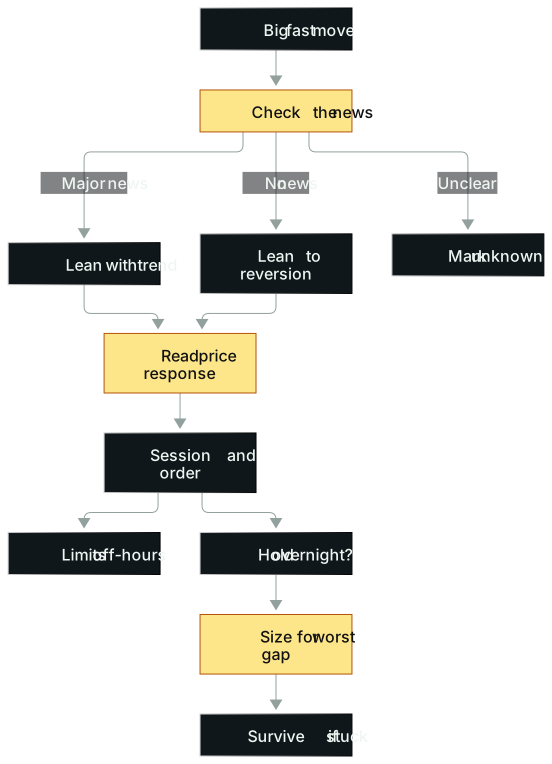
In words: When a big, fast move shows up, check the news first. News leans you toward the trend; no news leans you toward reversion; if you can't tell, mark it unknown. Let the price response confirm. Then two gates: how to place orders outside regular hours, and whether to hold overnight. Overnight size comes from the worst gap, not the stop distance.
Opening: a small leftover, months of drawdown
Lesson 2 mentioned an Allergan short. Here it is in full.
April 2014. A veteran US equities day trader, then three or four years in, had an equity curve just starting to turn up. A good month made about $15,000; his daily risk limit was roughly $3,500.
On a quiet weekday, Allergan, a big pharma company, spiked into the close. He read it as closing imbalance orders and expected the move to fade. He shorted before the close and kept a small piece overnight.
Soon after the bell, the stock exploded after hours on news that Valeant, teamed with Bill Ackman's fund, which had quietly built a stake of nearly 10%, was going after the company with an unsolicited takeover bid. By the time he saw the headline and understood it, the move was done. In minutes he lost over $80,000, more than twenty times his daily limit and several months of work. The whole trading group got hit.
His boss tried to console him, hoping he'd one day look back on it as a speed bump, but admitted he didn't know how it would end. For days he kept doing the math: six months to recover, a year, or never? The career he'd wanted, just showing promise, was threatened in a single day. This is a fat-tail accident: low probability, and once is enough.
His read that the spike was order flow was probably right. The mistake was the overnight hold, which swapped a usually easier-to-monitor and exit intraday exposure for an overnight one that is harder to handle in time. A daytime stop doesn't work after hours, when nobody is there to take the other side, and an intraday stop does not guarantee a loss cap either.
He later added strict daily, weekly and monthly loss limits (Lesson 14). This lesson is about the step before: when news comes, how price moves, and whether you can get out at that moment.
The idea
News is a repricing
What changes a security's fundamental value? Breaking news: earnings, mergers, offerings. With major new information, a stock has to find a new equilibrium, and that search can produce violent, lasting trends.
Other moves are just as big and fast with no new fundamental information. Statistically, moves without news revert more often than moves with news. Not always; a breakout from a clean base may never come back. Trading is stacking probabilities your way bit by bit.
Combine the two: with major new news, lean with the trend; with a big, fast move and no news, consider reversion. That filter is a screening rule to test, not a proven edge.
Why so powerful? The same pattern can have a different win rate and payoff in each environment, and that split needs to be tested. Breakouts on news and big moves without news often behave differently. Trading a strategy in the wrong environment means unknowingly fighting the strongest force in the market.
Think poker. Look only at your two cards and ignore the board, and you'll misplay. News is the board. If it didn't help you, bet less or fold.
The force comes from the gap to expectations
Whether news moves price depends on what the market expected. Merger arbitrage shows it: two stocks announced as takeover targets, one 2% below the offer price, another 20% below. The difference is the buyer, the regulatory approvals and the financing risk. Domain expertise spots the opportunity first; charts help execute it.
Not everyone has expertise, but everyone can watch the response. A bullish headline with little price gain means it was priced in, or someone is selling. A bearish headline that gets bought back quickly means the bad news was smaller than feared. The response is more honest than the headline.
The session sets your toll
Regular hours are 9:30 to 16:00 ET. Pre-market runs roughly 4:00 to 9:30, after-hours 16:00 to 20:00, and some brokers offer an overnight session from 20:00 to 4:00. All are real, tradeable sessions, with far fewer participants.
It's like buying a TV after closing time: fewer stores are open, and the ones that are charge more. For stocks that means wider spreads, thinner books, and tiny volume moving price a long way. Those awake face less competition, and pay more to get in and out.
Liquidity isn't only about the clock. On IPO day only a small slice of total shares can trade. Circle and Figma both opened more than 100% above their offer prices in 2025. The offer price is just what institutions paid in the deal. Once trading starts, supply and demand set the open. With IPOs, skip the valuation debate and ask three simpler questions: who wants to own it, who has to own it, and how many shares can actually be bought.
Overnight risk lives in the tail
During regular hours, day trading usually makes it easier to leave at your own pace, and that acts as a safety valve. Hold overnight and the valve is gone. A sudden news shock or a halt can also trap you during the day. Shorts are worse, because an upward gap has no theoretical limit. A micro-cap announced as a takeover target after the close can be up several hundred percent by morning.
So risk management can't rest on assuming you can always exit where you want. Overnight positions are controlled by size and concentration, not stops. A stop order is a price you hope to get, not one you're guaranteed.
The method
1. Log four things for every event
There's no time to think during the event, so set the format in advance:
- Release time and the earliest reliable source.
- What the market expected. With no consensus figure, write "no clear expectation." Don't invent one.
- The first price reaction. Direction, size, volume.
- Follow-through or reversal. Did it hold or get taken back? Was there a second headline?
It's a timeline, not a story. After-the-fact stories are always tidier than live information, which is why the live log is valuable.
2. News or no news picks your strategy family
Before every trade or backtest, answer two questions: is there major new news behind this move, and what kind?
| Major new news | No news | |
|---|---|---|
| Lean | Trend setups: breakouts, continuation | Reversion setups: exhaustion, cover |
| After a big rally | Possibly a new equilibrium | More likely technical overextension |
| Counter-trend trades | Far more cautious, or skip | Often the main opportunity |
Separate them in backtests too. Averaging breakouts with and without news blends two different probabilities, and the average is wrong for both. You might even discard a continuation strategy that works on news breakouts, just because too many no-news failures were mixed in (Lesson 25 covers backtesting).
News sources range from expensive to free. A Bloomberg terminal costs over $2,000 a month; dedicated news aggregators are far cheaper, mostly a hundred or two a month; and some free X accounts repost market headlines. The built-in news panel in your charting software is a click away.
3. Three hard rules outside regular hours
- No market orders. With thin books, a market order can fill far from the screen price. First confirm which order types your broker accepts in that session; do not assume a stop or stop-limit will be active. Only if those orders are clearly supported should you set stop-limit prices more aggressively than the trigger, and even then they may not fill. In the overnight session, use limits only, cut size, or don't trade.
- Price in the extra slippage first. This is one of the biggest beginner mistakes. Worse fills raise the bar, so be pickier.
- Check volume before using pre-market levels. If pre-market volume is a meaningful share of the stock's normal regular-session volume, those levels often matter. If it's a few thousand scattered shares, ignore them.
Pre-market news most often lands at 8:00, 8:30 and 9:00. Some trading floors have an unwritten rule: hands on the keyboard at those times. After-hours, the biggest opportunities come from earnings; Tesla, Nvidia and Apple all report after the close. Earnings moves are fast and brutal and best left to experienced traders.
Micro-caps have one more trap: they often announce offerings after hours, frequently right after the stock was pushed up in regular trading. Holding a micro-cap long after the close without thinking of this catches a lot of new traders.
4. Three questions before holding overnight
- Is there a known event tonight? Earnings, a Fed meeting, an index rebalance, an election. Check the calendar. One rule you could adopt: halve overnight exposure before major events.
- How big is the worst gap? A long can lose its whole stake; a short has no theoretical limit. A reference point of our own: even an aggressive short-term trader might cap micro-cap overnight size at 1.5% of the account. Not a universal number, but compare the order of magnitude with your own.
- If I can't get out, do I survive? The step passes only when the worst outcome tonight can't change whether you trade tomorrow.
5. Preparation beats in-the-moment brilliance
When big news hits, there's no time to think. Have these ready:
- An instrument basket. SPY, triple-leveraged SPXL or ES futures turn the same view into very different percentage P&L. Retail buying power is limited, so choose in advance.
- Aggressive enough hotkeys. A scenario of our own: the stock is at $180, big news hits, your hotkey bids only 5 cents above the last price, you want in at $180.60 and never get filled.
- Alerts. The Sunday alarm in the case below is one.
6. Write down both sides of the ledger
Halts, breaking news and overnight events are real risks. "What if it gets halted?" is one of the most common questions at trader meetups. A better answer is a question back: in the 10, 20 or 30 minutes you trade this stock, what's the actual chance of a halt? Then write the upside and downside on paper with estimated numbers. Once you're forced to write real probabilities and outcomes, the conclusion often differs completely from the one fear gave you. Everything has a worst case. What you compare is its probability and impact, and whether it's worth what it costs elsewhere in the ledger.
More real cases
Equally big and fast: Hertz and Nvidia
On April 17, 2025, Hertz jumped pre-market after rising more than 50% the day before. CNBC, citing sources, reported that Bill Ackman held close to 20% of the rental company through shares and swaps, and he called it undervalued. The move was several times the stock's average range, and a chart-only beginner would call it overextended and short it.
The conclusion runs the other way: the strong close and heavy volume made it a long candidate worth further evaluation.
Put it next to another chart: in the August 2024 Japan panic, Nvidia gapped down more than 10%. There had been a weekend report about a delay to one of its new chips, but that was small next to the macro panic: the drop came mostly from a global unwind, not from anything that changed Nvidia's business. This is a mixed case: company-specific news and a macro shock together, and the trader judged the macro factor as dominant. After a 10%-plus drop driven mainly by the tape, you cannot treat further shorting as an edge just because the move already looks large.
Both charts look scary. One has major news, so it may warrant considering trend-following; the other is driven mainly by a macro shock rather than the company news, so it may warrant considering reversion. Any edge still needs to be tested separately. The same word, "overextended," flips meaning in a different environment.
A smaller version: someone asked on social media what reasons might justify a swing long in First Solar (FSLR). Twenty-odd replies came in, and none mentioned news. One click on the news panel showed the US government had just raised tariffs on Chinese solar products, changing the competitive landscape for US solar companies at the root. No need to dissect the chart further.
Crude oil: when news arrives, ask whether supply disappears
On October 1, 2024, the US publicly warned that Iran would strike Israel. Crude dipped pre-market, recovered, and rose about $3 from $67 on the day, roughly 4–5%, a big move for oil. Most day traders' first instinct was to buy crude. The veteran's was too.
Then he paused and fit the news into his framework. He had followed oil for years and read fundamental research from specialist energy analysts. The core question: will physical supply actually be lost? Early in the Russia-Ukraine war and after the Abqaiq attack in Saudi Arabia, oil spiked and then fell back. Russian barrels kept flowing, just to different buyers. The Abqaiq attack did knock out a large share of Saudi output at first, but most of it was back within weeks. His default expectation was that most such events don't remove physical supply for long.
The strike was telegraphed, so part of it was priced in. Around 12:30, Israel closed its airspace and missiles flew, and oil rose only slightly. Then the airspace reopened, which he read as an all-clear. He started building a short in pieces.
Before sizing up he wanted three confirmations: price failing to push higher, the airspace-reopening headline, and a geopolitical analyst he trusted posting that the strike caused almost no casualties and Iran wanted minimal deterrence without escalation. Only when price broke and volume swelled with Bloomberg headlines did he really add.
There was restraint too. Risk-premium unwinds can be slow, so instead of trailing at the prior candle's high, he traded around the range. He covered some into flushes and re-shorted bounces, held some until later in the day, made little on part of it, and avoided much overnight risk.
By the close on Friday, October 4, oil was up nearly $8 from $67 and TV was shouting about $100 and $200. He still allowed that this time might differ, and some risk premium might stick, since nobody knew when Israel would retaliate. His question for each strike, escalation and spike: is this another case of more noise than substance?
The order has three layers: framework first, then whether the news fits it, then price and reliable sources confirming before adding size. The news itself is just material to confirm or reject the framework.
Once he missed his phone, once he set an alarm
Two events from the same year make a neat pair.
Friday, March 1, 2024. SMCI weekly calls he had sold were expiring that day, nearly worthless. He was a judge at a university competition, went out for pizza afterwards, and barely checked his phone after the close. When he walked in, his texts had exploded: SMCI was joining the S&P 500. The calls were exercised after hours. He noticed around 7 p.m., with the stock sharply higher. He gave no dollar figure, calling it his most frustrating, dumbest loss: he'd kept the position instead of closing it, and the market made him pay.
The detail: the options were nearly worthless, so they seemed harmless, so he didn't close them. A short option near zero isn't low risk. Its profit is already collected; only one-sided risk remains. With attention elsewhere and a position still open, this is what happens.
The same year, in the GME and AMC moves, he got a different kind of preparation right. He noticed Roaring Kitty's posts tended to appear around 8 p.m. ET on Sundays. He'd never traded overnight before that first post; afterwards he set a phone and calendar alarm every Sunday, about twenty minutes early, so he wouldn't be out at dinner. Before 8 he refreshed both X and Reddit. One day the Reddit post showed an all-in GME position, and his reaction was simple: confirmed. He went long, didn't scalp it out early since this was the biggest catalyst in the stock's history, and later shorted the reversal day.
The difference between the two is small: whether you're present when the event hits, and whether the position and information channel were set up in advance.
Tariff week: options ten minutes early, and point A isn't point B
During the tariff shock, NQ had an epic drop and oil fell near 55. Then Trump posted something close to a full reversal, and one of the biggest rallies on record followed.
One detail: about ten minutes before the news, just after 1 p.m., wave after wave of huge call-option volume hit. The veteran's read was that the price breakout was likely driven by that options flow rather than the other way round, with dealers forced to hedge into a gamma squeeze. That's his inference. The lesson: at moments like this, don't be trapped short, and vice versa. But when the move goes absurd, don't marry the idea that news decides everything either. He saw that NQ rally as wildly overextended and at one point a clear short, and only after price gave back more than half of that big candle did covering and flipping long make sense.
A related pattern: you miss the first leg after major news (point A), price pulls back deep to where it was before the news (point B), and many think "great, I can buy again." They often get flattened. Truly good news follows through with shallow pullbacks and steadily higher highs and lows. A deep pullback says the market is less excited than you thought, and that is information, like the card you wanted not coming. Point B isn't forbidden, but the same price can carry a different expectancy (Lesson 10 continues).
Common mistakes
1. Reading only the move and the pattern, not the news. Twenty-odd FSLR replies and none mentioned news. That binary decides how you trade the stock. Fix: before every chart, spend a minute on the news panel and write "yes / no / unclear" on line one of your notes.
2. Treating the news direction as the trade direction. War headline, buy oil. Fix: write down what real-world quantity changes if the news is true. If nothing physical changes, treat it as expectation, not fact.
3. Missing A and buying B. B is the same price as A, often with lower expectancy. Fix: after missing the first leg, check whether the pullback is shallow or deep. If deep, trade less or not at all.
4. Market orders or forgotten slippage outside regular hours. The screen price isn't your fill. Fix: limits only, a fraction of normal size, and a written slippage estimate for both ends before entry.
5. Using the stop as overnight insurance. With Allergan, the daytime stop never had a chance to fill after hours. Fix: size overnight positions for a gap to the worst level, not for the stop distance.
6. Freezing at the worst case. Many traders only ask "what if it halts" and "what if news hits" and never weigh the upside. Fix: write both sides with an estimated number each, then compare.
Where this applies
This works for events with reliable timestamps where you can review news and prints. A single social-media source isn't enough, especially for energy supply, regulatory approvals or corporate allegations; confirm with an independent source. AI is fast for research, say, checking how much of a software company's revenue came from China during the April 2025 export-control news. It can help you look things up. It shouldn't make the call, and don't trust it blindly.
Geopolitical judgments have a shelf life. "Most events don't remove physical supply" is a default built from years of watching, not a law, and some risk premium can stick.
For FX and CFD traders, news and session issues are more concentrated: spreads widen instantly around data releases, and the weekend gap is a bigger version of overnight risk. The same four-column timeline still works.
Practice: event timeline with a counterfactual
Material: this lesson's Hertz (2025-04-17) and Nvidia (August 2024 Japan panic) charts, or a finished earnings or macro data day of your own.
Steps:
- Hide the ten minutes after the event.
- Build a four-column timeline: known information, consensus, price and volume response, actions available at the time.
- Write three paths: continuation, failure and reversal, no trade. Give each an invalidation.
- Find a move of the same size with no clear news as a control. Compare duration, pullbacks, spreads and slippage. If you can't confirm whether there was news, mark it unknown rather than forcing a label.
- To practise extended hours, add: if the same signal appeared pre-market or overnight, what order type, size and worst slippage would you use?
Scoring (15 points):
- 3: sources and timestamps are clear; no "I heard."
- 3: the news is separated from its gap to consensus.
- 3: paths depend on price response, not the headline.
- 2: extended-hours order types and slippage risk are stated.
- 2: each path has an invalidation.
- 2: the control sample handles unknowns honestly and isn't cherry-picked.
Sample answer: bearish headline, but the first drop was bought back fast, so don't chase short. Trigger only if the event low breaks again with volume; if price settles back inside the pre-news range, drop the short idea. "Bad news, so short" scores zero.
Before holding overnight, add up your positions' worst gaps with the Portfolio Heat Calculator, and size each one with the Position Size Calculator using the worst-gap distance instead of the stop distance.
Tools you can use
- Portfolio Heat Calculator: the combined worst case of your overnight positions.
- Position Size Calculator: shares you can carry for a given gap distance.
How this connects
- Upstream: Lesson 5's setup definitions, Lesson 6's no-edge zones and Lesson 7's regimes. This lesson adds the "news or no news" variable.
- Downstream: Lesson 10 covers triggers and invalidation, and "A isn't B" previews it; Lessons 13 and 14 size positions and loss limits from the worst gap; Lesson 25 shows how to split news and no-news samples in backtests.
Practice this lesson in NQ Replay
FOMC, CPI, NFP and PCE times show as red lines on the chart (the built-in calendar currently runs to 30 September 2026), so on covered sessions you can rehearse your event-risk rules before the replay reaches the release. NQ Replay is our own app for practicing on past NQ futures sessions, replayed tick by tick in simulation, with bracket orders, prop-style loss limits and per-trade review. You can request a free 7-day trial; you'll need your own licensed NQ tick data.
For educational purposes only. This is not financial advice and makes no promise of returns. Tickers, dates and market moves in real trade examples come from public sources. Individual P&L and record figures have been adjusted. Illustrative figures are the author's own. Trading involves risk of loss.
Test it in the calculator
Before you hold overnight, price the worst night
If every position you hold tonight gapped to its worst level, what share of your account would you lose?
Example: $40,000 account, three overnight positions, $550 worst-gap loss each: $1,650, or about 4.1%.
Open the Portfolio Heat Calculator