
In one line: size is calculated, not imagined. Find the invalidation, decide what this trade may lose, divide and round down. Wider stop, proportionally smaller size; shorts, overnight holds and thin stocks get a further discount.
Lesson 13 of the 30-part Trading Decisions course. By Eliza.
Lesson map
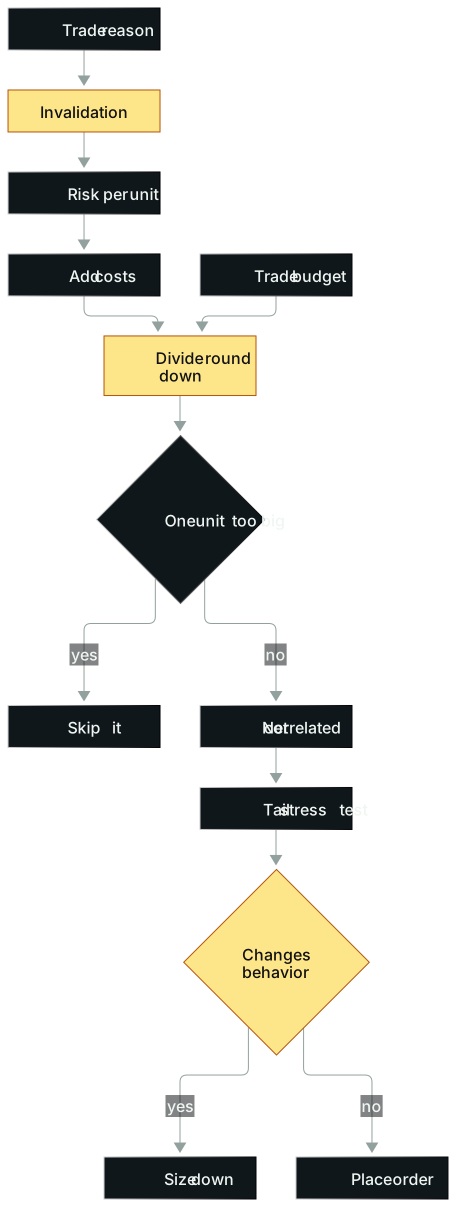
In words: The reason gives you the invalidation; the invalidation gives you risk per unit. Add costs and slippage, divide the budget by it, round down. If even the minimum unit doesn't fit, skip the trade. Positions on the same theme share one budget; then stress-test gaps and slippage. The last gate: will this size make you hesitate, bail early or stare at P&L? If so, size down one notch.
Opening: 400 shares or 1,600
A trader still in training handed in a review. One trade was QBTS. The company had landed a contract, the stock consolidated, and he bought the break of the premarket high: 400 shares, up $120. The review first said he should have used much bigger size. The next line said he only bought 400 shares, but that was the best he could do.
The veteran reviewing it locked onto those two lines and asked three questions. How much should you have bought? Why that much? And why might you have bought too little?
The answer was further down. He wrote that to be aggressive he could have bought 1,600 shares, and a stop-out would have cost $240. But his daily loss limit was only $400, and one trade shouldn't eat most of it. The veteran nodded at that: he really was weighing the trade-offs of size.
Lay out the numbers. 400 shares for $120 is $0.30 a share. 1,600 shares losing $240 at the stop means a stop distance of $0.15. Working back, 400 shares carried $60 of planned risk and 1,600 carried $240 (those two risk figures are derived here; the review didn't state them). The 1,600-share version alone takes 60% of the $400 daily limit. If it loses first, $160 is left for every other chance that day.
So 400 wasn't a guess, and neither was 1,600. Both had math behind them, and that step he got right.
What the veteran really wanted to know was something else: was the small size calculated, or scared? His point was that if someone keeps trading undersized, or keeps getting scared out of good entries early, you dig a layer deeper and find out why, while the trade is fresh and the memory is clear.
Small size from math is discipline. Small size from fear is fear. In the account they look identical. Only one thing tells them apart: writing size as a formula where every number has a source. That formula is this lesson.
One more note: the veteran's overall verdict was that the stock and setup were right, and the highest-return fix was in holding rules; the adds were a bit random. Size is half the ledger. The other half is managing the trade once you're in (Lesson 12).
The idea
The order: reason, stop, budget, size
Most people size backward: decide what size would be exciting, then squeeze a stop in so total risk lands on the number in their head. Flip the order. The most expensive counterexample is Avis. On November 2, 2021, a veteran day trader shorted Avis with an annual profit target weighing on him and let size follow the target. He was down seven figures in a little over forty minutes. His own takeaway was that he had let the goal set his size instead of his edge (Lesson 22 goes into it).
A plain example, with our own numbers: stop distance $1, willing to lose $400, buy 400 shares. Stop becomes $4, you can buy 100. As a formula:
Size = risk budget per trade ÷ (stop distance per unit + cost and slippage allowance per unit)
400 ÷ 1 = 400, 400 ÷ 4 = 100. You can check it at a glance. The order decides what's the input: the reason gives you the stop, you set the budget, and size is the output.
A stop marks the edge of the risk; size decides whether you're still standing when price hits that edge. Sizing may be the stronger risk tool, because it caps the damage of a mistake before the mistake happens. With the right size, gaps, halts and surprises do less damage. With the wrong size, the best stop in the world won't save you. Heavy slippage, violent gaps and halts happen far more often than inexperienced traders think. They aren't black swans; they're routine.
Get the units straight
"Per unit" has to mean something specific.
- Stocks: per share. A $1 stop times 400 shares is $400 of risk.
- Options: a $2.50 quote is per share, and a standard contract covers 100 shares, so one contract is $250.
- Futures: multiply by point value. NQ is $20 a point.
- Crypto: check the exchange's minimum step, and read the funding and liquidation rules.
Get a unit wrong and the budget is meaningless. Notional value and margin aren't your max loss. Margin is the entry ticket; planned stop-loss loss is stop distance times quantity.
Wider stop, proportionally smaller size
When that veteran moved from day trading to swing trading, size was where he struggled most. His intraday stops were sometimes only $0.50 or $1. Swing stops are naturally wider, but he kept his day-trading size. Size was so big that he couldn't stomach normal swings inside the setup, so he kept intervening and took his own system apart: he kept getting scared out of trades that hadn't broken a single rule.
His fix was a hard rule: if the stop gets three times wider, size should shrink to roughly a third. Traders hate it, he noted, because small size isn't exciting.
Overnight adds another layer. An intraday stop might be 20 to 30 cents; over several days a sensible stop might be $2 from entry, already 7 to 10 times the distance. Then there are gaps. With our own numbers: the stock is at $40 at bedtime, your stop is $38.50, planned risk $1.50 a share. Bad news overnight, it opens at $34, and you actually lose $6 a share, four times the plan. The risk you think you're taking and the risk you're actually taking can be completely different. His rule of thumb: overnight size is usually half of normal intraday size, often less.
High-volatility days work the same way. During the tariff shock someone asked him whether that was the time to bet bigger. Yes, he said, but bigger in dollars at risk, not necessarily in shares. Lesson 7's SPY illustration did the math: if the daily range goes up tenfold and shares stay the same, dollar risk goes up tenfold too. To keep dollar risk where it was, share count has to come down.
Be much more conservative short than long
Long a stock, the worst case is zero: buy $10,000 and you can lose at most $10,000. That ceiling lets a long-only trader size even without a stop by assuming a total loss. Short is the opposite: profit caps at 100%, and losses in theory have no limit. Stocks like ZJYL have gapped up several hundred percent in a very short time; a $5 stock can open at $15, $30 or higher with no chance to get out first. Careers and finances wrecked by moves like that aren't rare.
The Avis trade was a short. He took the loss at $385; the stock later ran to around $550. Holding on would have cost roughly another $165 a share.
Set your own parameters with this structure. These are our own illustrative numbers for a trader who likes to swing big: no single trade above 40% of the account, no single short above 20%, no overnight microcap position above 1.5%. Don't copy the numbers. Copy the structure: shorts lower than longs, overnight lower than intraday, thinner stocks lower still.
Grade opportunities, but only once the basics hold
This cuts both ways: don't treat every opportunity as equal, and don't bet bigger before you're ready.
The case for betting more on your best setups comes from poker. Bet $100 on seven-deuce and $100 on pocket aces and you lose over time, because bad and average hands outnumber great ones by orders of magnitude. Early on, that veteran sat next to his boss taking the same trades. The boss made a lot; he lost money. The only difference was that the boss bet far bigger when the good hands came. A new hire from his cohort had lightning reflexes but kept the same size for three years and eventually didn't make it.
Another trader shows how data turns into size. He found that the "first red day" setup worked the large majority of the time in his sample, upward of 85%. His partner treated it as an ordinary C-grade trade; he used backtests and his own stats to scale it up. Data first, size second.
The practical tool is a sizing card. A card on the desk reads A, B, C, D, where D means no trade, and each grade lists how much risk it gets. To raise size, change the card first, then look at it every day. It forces you to grade each trade before you enter and answer one question: does my size match this grade, or is it too small or too big?
Scale up in order. Our own numbers for illustration: start uniform, say $80 of risk or 1% of the account per trade; then linear, $80, $120, $160; then exponential, $80, $160, $320; and only after that, very large amounts. At professional firms almost nobody stays uniform past the first few months. But exponential sizing isn't advice for beginners: you have to master your setups first.
Keep the steps small, too. One swing trader jumped his A+ risk from about $34,000 straight to about $68,000 and traded terribly. A 100% jump in risk is something almost no trader can adjust to (Lesson 18 covers it). His usual habit was raising each tier about 10% a month. That sounds laughable, but compound it: 10% a month is about 3.1 times in a year; 10% every two weeks, 26 times a year, is about 11.9 times. Small steps aren't slow.
The method: five steps to size a trade
- Write down invalidation and risk per unit. Invalidation comes from Lesson 11. Risk per unit = distance from entry to invalidation + cost and slippage allowance per unit.
- Set the per-trade budget. It's capped by strategy variance, max losing streak, correlated positions, overnight tails, what the money is for, and how much you can stomach. Without data, use one small uniform number, say 1% of the account or less.
- Divide and round down. 1.5 contracts is 1, not 2.
- If one minimum unit exceeds the budget, skip it. Don't nudge the stop a few ticks closer so one contract fits.
- Net out correlated positions, then stress the tails. Positions on one theme share one budget.
A worked example
These are our own teaching numbers, not trading advice. An account caps planned risk per trade at $500.
NQ. Structural stop 16 points, $20 a point, plus a $40 slippage allowance per contract:
Stressed loss per contract = 16×20 + 40 = $360 Contracts = 500 ÷ 360 ≈ 1.39, rounded down to 1 contract.
With a $300 budget: 300 ÷ 360 ≈ 0.83, less than one contract, so skip. A smaller contract is an option, but recheck its point value.
BTC. Same logic. Stop distance $1,000, cost allowance $50, risk per 1 BTC $1,050:
Quantity = 500 ÷ 1,050 ≈ 0.476 BTC. With a 0.01 step, take 0.47 BTC; planned risk 0.47×1,050 = $493.50, inside $500.
Correlated, same direction. Say the account gives "same-direction crypto" a combined budget of $800. ETH in the same direction already uses $350, leaving $450 for BTC:
Quantity = 450 ÷ 1,050 ≈ 0.428, step down to 0.42 BTC, risk 0.42×1,050 = $441.
Three tech longs can each pass on their own and add up to triple the exposure to one theme.
Stress test. These run on the standalone $500 BTC budget from the first example, not the correlated $450 case. Ask three questions and attach an action to each:
- Slippage doubles. NQ allowance goes from 40 to 80: 16×20+80 = 400 per contract, 500÷400 = 1.25, still 1 contract. BTC cost goes from 50 to 100: 1,100 per BTC, 500÷1,100 ≈ 0.4545, take 0.45 BTC, risk $495.
- A gap to twice the stop distance. NQ gaps 32 points: 32×20+40 = $680 per contract, $180 over budget. With a hard daily limit of $900, $680 is about 76% of it. It barely fits, but one contract eats most of the day. With a $600 hard limit, even one contract doesn't fit. Skip.
- All three instruments drop together. Total the correlated loss and check it against the daily limit; if it's over, cut the weakest position first.
The psychological ceiling
Size must never get big enough to change how you behave in the trade. If it makes you hesitate, exit early or get attached to the P&L, it's already too big. The setup didn't change; you did. Everyone has a threshold, and past it you stop trading the setup and start trading the account balance. Find yours and stay under it.
More real cases
2025 collateral: the costliest sizing error was inside the account
In 2025 the veteran's own account had a serious problem. No single trade was too big; he ran short of ammunition. For most of his career he had traded at firms, using their buying power. The collateral in his own account was almost all long-term stock holdings: SPY and some long-held names. In the April tariff selloff some of those fell 30% or more, buying power got squeezed hard, and the market was offering the best opportunities of the year.
He didn't want a margin call, so he sold to realize losses and cut exposure, while trading only a fraction of the size he'd planned. Counting realized losses and missed opportunities together, he put the cost at seven figures. His conclusion: what hurt wasn't how far the long-term holdings fell, but having his hands tied during the days with the best odds.
This ties straight back to the formula. The budget is per trade; buying power belongs to the whole account. When the best opportunities show up you need to be able to take the right size, or a correct formula has nothing to multiply. Afterward he cut his investment holdings sharply, made the portfolio more liquid, and started stress-testing his collateral under different market scenarios.
Bitcoin at $75,000: built the position, then shrank it himself
Around the 2024 election he liked a cup-and-handle in bitcoin: a base from around $70,000, then after the August 5 flush, higher highs and higher lows up to resistance between about $73,800 (the March high) and $75,000, with the election as a catalyst. He ranked it his second-best opportunity of the year and didn't think buying the breakout was dangerous. He bought a lot of options and built a huge long. Then he told himself that at that size he wasn't going to sleep for two weeks.
He cut a big chunk. He later filed it as a lifestyle trade-off, not a trading mistake: it was a price he didn't want to pay again.
Bitcoin trades 24 hours a day, seven days a week, so with oversized positions no night is safe. That position wasn't stopped out; his sleep took it out. He also admitted that the election trades, mainly bitcoin and Tesla, were where he underperformed most that year. Size has costs beyond the odds of losing money, including sleep and attention (Lesson 20).
The smallest lot, and the extra zeros on the boss's share count
The trader from Lesson 11 who shorts parabolic stocks knew coming in that he'd struggle for a while, so during his learning phase he traded only the smallest lot and waited until his stats could support more. His account turned green after eight or nine months. His starting class had about a dozen people. Over a year or two they left one by one, until only he and one other remained. Early on, protecting your head matters as much as protecting your capital.
The veteran had his own realization when he was young. Sometimes he executed a trade as well as his boss did; the boss made $3,000 or even $30,000, and he made $300. Same moves, but the boss had one or two extra zeros on his share count, so he had one or two extra zeros on his profit. A common beginner mistake is believing capital creates opportunity. Skill earns the opportunity; money just magnifies it.
Put the two together. Small size is for building skill. Once the skill is there, scaling up is the easy part, and the market always finds a way to lend leverage to people who know what they're doing.
Common mistakes
1. Picking the size, then fitting a stop into the budget. Backward: start with the number you want to make, then find a size. That's how the Avis trade happened. Fix: draw the invalidation first, then calculate size. Size is an output, not an input.
2. Volatility jumps, size stays, stop tightens. That keeps dollar risk the same by breaking the strategy. Most people keep their usual size in wild markets and then set stops tighter than the system calls for, which breaks the system (Lesson 11). Fix: let distance widen with the setup and shrink size.
3. Watching margin and notional instead of risk per unit. How much margin one NQ contract needs says nothing about planned stop-loss loss. Fix: stop distance times point value.
4. Giving each correlated position a full budget. Three same-direction tech longs are one problem. Fix: one theme, one budget.
5. Swimming in someone else's lane. One trader made a mid-six-figure income and was surrounded by seven-figure peers. He tried trading their size and his account started bleeding; he went back to two to five contracts at a time, in and out, and steadied. His reminder to himself: stay in your own lane. Fix: your size ceiling comes from what you can handle, not from someone else's numbers.
6. Treating "I'm really sure this time" as a grade. Grades come from rules applied with the outcome hidden. Fix: write testable conditions for A grade; if you can't, size it as a B.
Where this applies
- Planned risk isn't guaranteed risk. A stop order doesn't guarantee a fill price; gaps, halts and platform failures can push the real loss past the plan. Smaller size can reduce those losses, but it does not guarantee a maximum loss; positions such as short stock can still have theoretically unlimited losses.
- Options are nonlinear. A 1% to 2% move in the stock can mean a 30% to 50% loss on the option. Stress-test buyers and sellers separately: for a standalone long option, test a 50% premium decline and a total loss of the premium paid; for a short option, test whether you can still accept it if the buyback price doubles, then doubles again. These scenarios are not maximum-loss limits.
- This lesson gives no universal account percentage. Strategies and personal situations differ too much, and copying someone's amounts or tiers buys only false safety.
- If living money, debt, emergency savings and trading capital are mixed together, cut risk or stop first. Optimize later.
- Breaking your own rules isn't always wrong. Around 2020 the veteran took a big position in crude oil futures, definitely not in his playbook. But he wrote down beforehand why and how, and kept a safety buffer. The preconditions: a reason to think it might work, acceptance that it might not, and protection set up first.
The same applies in FX and CFDs; only the units change. Lot size times value per pip, then check the platform's minimum lot. Pip value changes with the pair and the account currency, so don't go by memory.
Practice: a three-instrument sizing and portfolio stress sheet
Material one, outcome hidden: the QBTS trade. Use only the entry, the $0.15-per-share stop distance and the $400 daily loss limit. Write your per-trade budget and calculate the share count, then compare with the review's 400 and 1,600. Answer: is your small size calculated or scared?
Material two: design one hypothetical trade each for NQ, BTC and ETH. Fill in: invalidation, stop distance, unit value, cost allowance, risk budget, theoretical quantity, rounded-down quantity, planned risk. Add two stress scenarios: slippage doubles; correlation across all three suddenly rises. Finish with total portfolio risk and the positions you must cut.
Scoring (14 points):
- 3: every stop comes from invalidation, not backed out of size.
- 3: units, point values, multipliers and formula correct.
- 2: quantity rounded down; skipped if one minimum unit exceeds the limit.
- 2: cost and slippage allowance included.
- 2: correlated exposure counted against a portfolio cap.
- 2: at least two tail scenarios completed, each with an action.
Reference: a passing answer to material one reads roughly: $400 daily limit, per-trade budget a quarter of that, $100; 100 ÷ 0.15 ≈ 666, rounded down to 600 shares in hundreds (round lots are this exercise's convention; US stocks also trade in single shares), before costs. 400 shares is conservative but defensible; 1,600 uses 60% of the daily limit in one trade and fails. Listing only notional, treating margin as max loss, or sizing up to hit a target amount fails.
Plug the budget, entry and stop into the Position Size Calculator and it returns the rounded-down share or contract count. For FX and index CFDs, PipGauge's Lot Size Converter and NAS100 Point Value Calculator keep the units straight.
Tools you can use
- Position Size Calculator: risk budget ÷ stop distance = size.
- Lot Size Converter (PipGauge): convert between standard, mini and micro lots.
- NAS100 Point Value Calculator (PipGauge): value per point on NAS100 CFDs.
How this connects
- Upstream: Lesson 11 gives the stop level, which this lesson turns into risk per unit; Lesson 3's expectancy decides how big a budget a setup deserves.
- Downstream: Lesson 14's daily, weekly and monthly loss limits are the hard caps in this lesson's stress test; Lesson 15 covers when to add and when you must cut.
- Alongside: Lesson 22 reviews the Avis day in detail; Lesson 18 covers rebuilding size in stages after a drawdown; Lesson 20 covers sleep and attention.
Practice this lesson in NQ Replay
Decide the dollar risk first, size NQ or MNQ from the stop distance, and let the bracket order hold that stop for you. NQ Replay is our own app for practicing on past NQ futures sessions, replayed tick by tick in simulation, with bracket orders, prop-style loss limits and per-trade review. You can request a free 7-day trial; you'll need your own licensed NQ tick data.
For educational purposes only. This is not financial advice and makes no promise of returns. Tickers, dates and market moves in real trade examples come from public sources. Individual P&L and record figures have been adjusted. Illustrative figures are the author's own. Trading involves risk of loss.
Test it in the calculator
Stop is set. Let the formula pick the size
Given what you'll risk and how far the stop is, how many shares can you buy?
Example: $400 budget, entry 36.00, stop 35.00, $1.00 risk per share: 400 shares max, before costs. Move the stop to 32.00 and risk is $4.00 a share: 100 shares.
Open the Position Size Calculator