
The short version: the market decides whether a trade made money. You decide whether it was worth taking. Keep two sets of books.
Lesson 1 of the 30-part Trading Decisions course. By Eliza.
How this lesson fits together
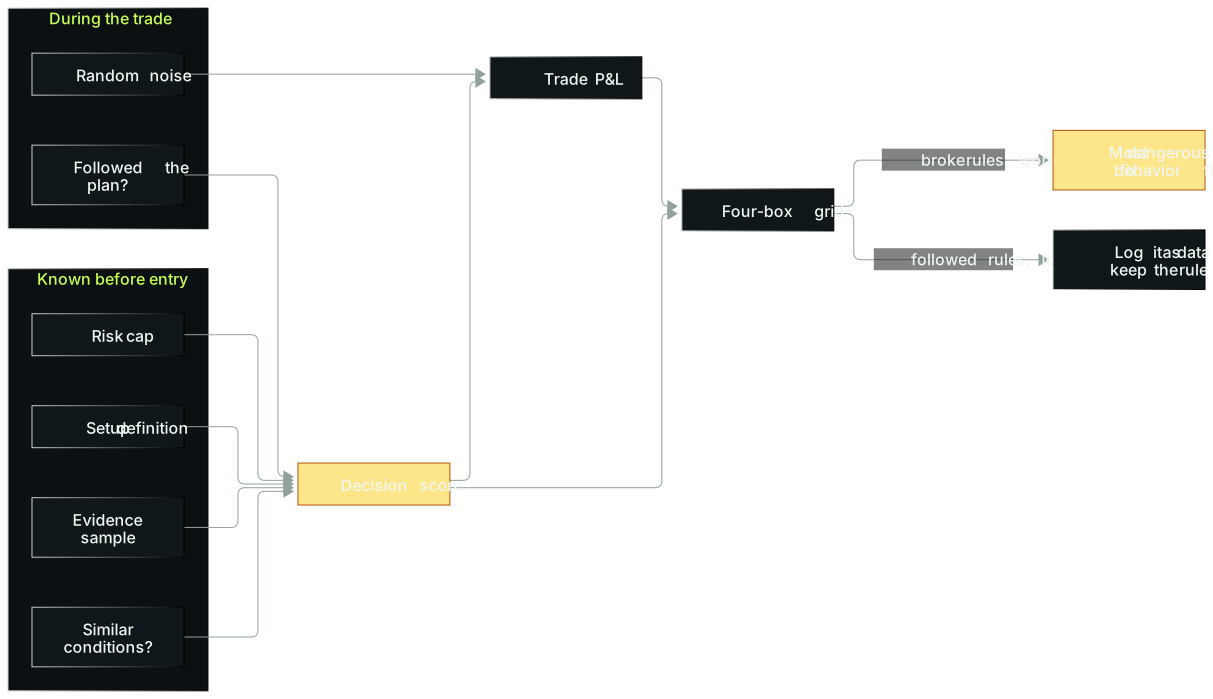
In words: (1) Four things you can settle before entry (setup definition, evidence sample, risk cap, how similar the conditions are) plus one from the session (did execution follow the plan) combine into a decision score. (2) The P&L of a single trade comes from that score plus random noise. (3) Cross decision quality with P&L and you get four boxes. (4) "Broke a rule, made money" is the most dangerous box: fix the behavior first. "Followed the rules, lost money" goes into the sample, and the rules stay as they are.
Pocket aces, first one out
Picture a poker game. First hand, you look down at two aces. You shove all-in before the flop, and the player across the table calls with whatever junk they happen to hold.
Aces against a random hand win roughly 85% of the time before the flop. There is no more clear-cut good decision in hold'em. Play that spot 20 times and you win about 17 and lose about 3.
Tonight is one of the 3. The board runs out, your opponent makes two pair, and you're the first person at the table heading for the exit.
On the drive home you get to pick a story. "Bad run tonight" is close to the truth. "I'm bad at poker" feels more honest and is far more likely to make you abandon a correct play.
Trading is harsher than poker in one way. When you lose a hand, at least the cards get turned over and you see what beat you. When you lose a trade, the market shows you nothing. You fill in the blank yourself, and most people fill it with either "I'm no good at this" or "the market is rigged." Both stories lead you somewhere bad.
Why one result can't grade a decision
Every P&L number is three things blended together
- The long-run distribution of the method. Take the same kind of trade a thousand times. Does it make money on average, and how much?
- This particular execution. Did you enter and exit as planned? Did the size quietly grow?
- This particular dose of randomness. You can't control it and you can't forecast it.
The single number on your screen is all three stirred into one pot, and there is no way to unstir it. Grading a decision by its result is like judging a chef's knife skills from one spoonful of soup that a stranger has just salted.
Expectancy is what "good decision" means in numbers
Here's a coin game. Heads, I pay you $250. Tails, you pay me $100. Would you play?
Each flip is worth 0.5 × $250 − 0.5 × $100 = +$75 to you on average. Clearly worth playing. Neither of us has any idea what the next flip will be.
That is the question professionals are actually answering every day: if this exact situation could be replayed a thousand times, would I take it every time? That question has an answer. "Will this one work?" does not. Beginners spend their energy on the second question. Experienced traders spend it on the first.
As a formula:
Expectancy = win rate × average win − loss rate × average loss − cost per trade
Run the numbers on a sample method: 40% win rate, $300 average win, $150 average loss, $10 in costs per trade.
0.40 × 300 − 0.60 × 150 − 10 = 120 − 90 − 10 = +$20 per trade
That's a positive-expectancy method. Now the uncomfortable part: the chance it loses five in a row is 0.6^5, about 7.8%. Pick any five consecutive trades and roughly one time in thirteen, all five are losers. What you feel during those five trades tells you almost nothing about what the method really is.
One more thing people skip over. Win rate and average win aren't constants printed on a label. You estimate them from backtests, replay and live records, and they drift as conditions change. "This setup has an edge" is closer to a medical checkup than a lifetime license. It needs re-testing (Lesson 3 covers how to estimate it and how much to trust the estimate).
Making money can still be a bad decision
Split decision from outcome and you get four boxes:
| Made money | Lost money | |
|---|---|---|
| Followed the rules | Good decision, good outcome | Good decision, bad outcome |
| Broke the rules | Bad decision, good outcome | Bad decision, bad outcome |
The bottom-left box is the dangerous one. Money is a reward, and rewards train behavior. A winning rule-break is like running a red light and having the cop who saw you hand you a hundred-dollar bill. Of course you're happy. And you'll run the next one too.
Beginners celebrate those trades. Experienced traders are a little embarrassed by them, because they know they just got paid to build a bad habit (Lesson 23 covers what to do with them).
The top-right box feels the most unfair, but it isn't a mistake. It's a data point. Rewriting your rules because of it is like folding aces from now on because you lost with them once.
The five-point pre-trade check
You should be able to grade a decision before you enter, using only what you can see at that moment:
- Setup definition. Can you describe which kind of trade this is using observable conditions? "It looks strong" isn't a definition.
- Evidence. Is there a continuous sample behind this type of trade, from backtests, replay or forward-test logs? A folder of winning screenshots doesn't count.
- Risk cap. Before entry: where you're wrong, how much you can lose, how big the position is. Changing 1R after the trade goes against you is an automatic fail on this line.
- Execution. Did entry, management and exit follow the plan? Moving your stop further away is a violation, even if the trade ends up green.
- Fit with conditions. Do today's volatility, liquidity and event risk resemble the conditions your sample came from? If not, discount the win rate you're counting on.
Look at those five items from another angle and they boil down to one question: should this trade have been taken, and was it taken properly? Set the result aside and ask three things. Is it on the list of setups you wrote down? Did the entry and the management stay on plan? Is the risk the amount your own records support? Pass all three and it was a trade worth taking, even if it lost.
All five pass and it loses: log a compliant loss. A key item fails and it wins: log a non-compliant win. Neither label requires you to be kind or harsh with yourself. Just honest.
More cases
Right on direction, still lost money
Options make the point cleanly. Say a used motorcycle is worth $800 today. You pay $30 for the right to buy it at $800 on expiry day.
Expiry comes and the bike is worth $815. You called the direction. But your right is only worth $15, and you paid $30 for it, so you're down $15. The bike needs to reach $830 just for you to break even.
Same-day options make it even more obvious. At 10:00 a.m. you pay $80 for an at-the-money call. The index goes sideways all day. By 1:00 p.m. the option is worth $55, by 3:00 p.m. $25, and at the 4:00 p.m. close it's worth nothing. You weren't wrong about direction and nothing crashed. The clock just kept running while the move you needed never showed up.
Cost, time and volatility sit underneath every result, next to your actual read, and all of them can be priced in before you click buy. If your review only asks "was I right about direction?", you'll draw the wrong conclusion and feel very confident about it.
The hiring rule that rejected the wrong person
Say you run hiring and set a rule: anyone more than 20 minutes late to an interview without giving notice doesn't get a second round.
Over a year, the rule screens out 30 people. Looking back, 27 of them really weren't a fit. Three were late because your team sent them the wrong time.
For those three, the outcome was wrong. The rule was still made on sound premises. When you're sorting through a pile of candidates, you need heuristics that are right most of the time. Whether to change the rule is a separate calculation: are 27 avoided bad interviews worth 3 wrong rejections, and is there a cheap patch, such as one confirmation call before rejecting someone?
Trading rules work the same way. One wrong call doesn't overturn a rule. A sample does.
A seven-figure loss in 40-odd minutes, graded in two parts
This one is a real trade. On November 2, 2021, a veteran US equities day trader shorted Avis (CAR) and was down seven figures within 40-odd minutes. It was one of the most painful trades of his career (Lesson 22 goes through it in detail).
In his review he didn't throw the whole trade out. He graded it in two parts. The setup passed: it was a pattern he had traded many times with a real edge, and he'd take it again. The size failed: it was far beyond what his own rules allowed.
He didn't blacklist the setup because it lost money, and he didn't excuse the size because the setup was valid. That is what grading a decision in pieces looks like.
The people in the biggest hurry learn the slowest
There's a type of new trader you see over and over. Small account, a feeling of being behind in life, and a plan to squeeze ten years of skill into six months. So they size up, blow the account, deposit again to win it back faster, and blow it again. Then come the revenge trades, the strategy-hopping, the indicators, the paid chat rooms. A few years later they're right where they started.
The people most desperate to get rich quickly are usually the slowest learners, and this lesson is why. Every trade feels like life or death to them, so every result trains them. A win reinforces the risk-taking. A loss reinforces the panic. They never learn anything at the decision level, because the outcome level is always in the way.
Common mistakes
1. Thinking one or two winners means you've figured it out. Nobody hits one three-pointer at the park and decides they're the next Steph Curry. Traders do the equivalent all the time. Fix: before any conclusion, ask how many trades it's based on.
2. Only collecting the winners. If your screenshot folder is all green, your win rate and average win are inflated. Fix: log every trade that meets the definition, wins and losses in the same table.
3. Using hindsight in your review. "And then it ripped" is not an entry reason. Fix: hide everything after the entry and review only what was visible at the time (Lesson 22 is built around separating facts from interpretation).
4. Resizing 1R after the loss. Move the stop and the size of R changes, so the trade can't be compared to anything else (Lesson 2). Fix: lock 1R before the order goes in. Afterward you can log a violation, but you can't edit the books.
5. Reading "positive expectancy" as "the next one should win." The +$20 method above has close to an 8% chance of losing five straight. Some people respond with "anything can happen, so why bother with the math?" Randomness is real. The math exists to shift the distribution of many trades in your favor. Fix: run your numbers through a losing streak calculator so you know what a normal bad run looks like before you're in one.
Where this breaks down
This framework works for trades where the rules can be written down beforehand and the results can be logged over and over. The strategy doesn't need to be fully mechanical, but a reviewer should be able to tell whether a trade met the conditions at the time.
Historical expectancy stops being reliable when the sample is tiny, the market structure has shifted, cost data is missing, or the trade depends on one-off information that can't repeat. In those cases, hold your conclusions loosely, cut or pause risk, and gather more data. A formula won't make you brave, and it shouldn't.
Exercise: the two-axis decision log
Material: From your own replay or history, find one trade that made money while breaking a rule and one that lost money while following the rules. If you can't find your own, use two cases from this lesson: the Avis trade (setup passed, size failed) and the hiring rule (sound rule, wrong individual call).
Steps:
- Hide everything after the entry. Look only at what was available at entry and before.
- Fill in, line by line: setup definition, evidence visible at the time, invalidation, planned risk, actual execution, final result.
- Give two scores: decision quality from 0 to 10, and the result in R multiples only. Don't add them together.
- Write a 150-word conclusion: without knowing how the chart played out, would you approve this trade, and why?
Scoring (10 points):
- 2 pts: setup conditions are specific and observable, with no after-the-fact language like "it looked good."
- 2 pts: risk and invalidation were fixed before entry, and 1R wasn't changed afterward.
- 2 pts: you separated what was knowable at the time from what couldn't have been known.
- 2 pts: you separated execution errors from strategy failure.
- 2 pts: the conclusion doesn't depend on the final P&L, and states how many more trades you'd need before changing the rule.
For reference: a fully compliant −1R trade can score 9 or 10 on decision quality. A trade where you chased the entry, quietly bumped risk from 1R to 1.5R and finished +2.5R scores 4 at most. If the main reason in your answer is "because it went up later" or "because it went down later," you get zero on the evidence and conclusion lines.
You can keep this log in the Trade Journal Analyzer, with decision score as its own column.
Tools for this lesson
- Expectancy Calculator: plug in win rate, average win and loss, and costs to see what a type of trade earns per trade on average.
- Losing Streak Calculator: see how long a normal losing run is for a positive-expectancy method.
- Trade Journal Analyzer: track decision scores and outcomes separately.
- Further reading: win rate vs expectancy vs payoff ratio.
Where this leads
- Next: Lesson 2 converts every P&L into the same unit with R multiples, and Lesson 3 estimates expectancy from a sample. Together they turn "decision quality" into numbers you can calculate.
- Later: the single-trade review in Lesson 22 and the scorecard in Lesson 24 both depend on the rule from this lesson: decision score and result score are logged separately.
- The psychology side: Lesson 19 on outcome attachment covers what this idea looks like emotionally.
Practice this lesson in NQ Replay
Replay a session you haven't seen, score each decision before you look at the P&L, and count how often a good decision still lost. NQ Replay is our own app for practicing on past NQ futures sessions, replayed tick by tick in simulation, with bracket orders, prop-style loss limits and per-trade review. You can request a free 7-day trial; you'll need your own licensed NQ tick data.
For educational purposes only. This is not financial advice and makes no promise of returns. Tickers, dates and market moves in real trade examples come from public sources. Individual P&L and record figures have been adjusted. Illustrative figures are the author's own. Trading involves risk of loss.
Test it in the calculator
Check the expectancy of your setup
Do your win rate, average win, average loss and costs add up to a positive number?
Example: 40% win rate, $300 average win, $150 average loss, $10 cost per trade comes to about +$20 per trade.
Open the Expectancy Calculator