
In one line: skill runs ahead of P&L, so a few losing months do not prove you can't do this, but sticking around does not win by itself either. Let the red lines veto first, answer three progress questions without looking at P&L, then price the opportunity cost. Continue, pause or quit, each goes on paper with a deadline, a budget and a review date.
Lesson 30 of the 30-part Trading Decisions course. By Eliza.
Lesson map
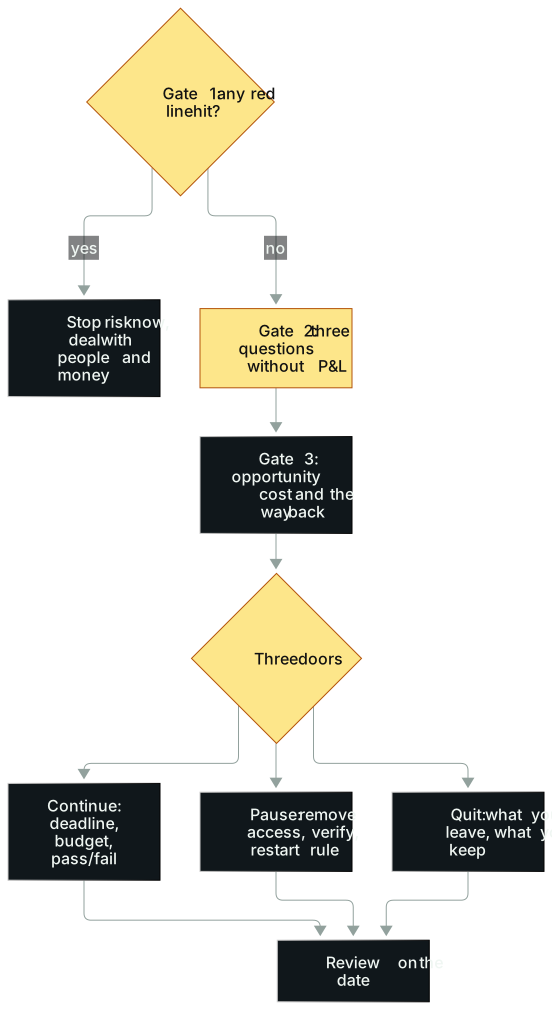
In words: (1) Gate one checks three red lines: mental health, close relationships and living money. If any one is hit, stop taking risk immediately and deal with the person and the money before anything else. (2) Gate two sets P&L aside and answers three progress questions, each pointing to a specific record. (3) Gate three compares opportunity cost and the way back: what you would actually do instead, and whether the choice can be reversed. (4) There are only three doors. Continue needs a deadline, a budget and pass and fail criteria. Pause needs the access you will remove, what you will verify and the evidence that lets you restart. Quit needs what you are leaving and what you are keeping. (5) Every verdict gets a review date, and you do not rewrite it in the middle of a session when emotion is running highest.
Opening: eighteen months in, résumés out
A finance major read a few books of trader interviews and applied to every Wall Street job he could find. A big bank offered him a trading seat with a very decent salary. He turned it down and joined a day trading firm that paid almost nothing. His classmates thought he had lost his mind.
He was sure of exactly one thing: nobody at the firm would outwork him. Every Sunday he was at the office with a few slices of pizza and a muted football game on the TV, flipping through charts hour after hour, taking apart every trade he had made, rewatching his recordings.
At the end of year one he ranked near the bottom of a class of twenty-something. He had not just failed to make money; he had cost the firm money, and he would have to earn that back before any bonus was possible. Around the eighteen-month mark he started sending out résumés. Quant shops, banks. The rejections came back one by one. He took a beating from the market by day, read rejection emails at night, and lived on sandwiches from a fast-food counter. People from his class were leaving around then, not fired, just out of hope. Simply by lasting that long, he had already outlasted roughly half of them.
He wanted to resign but could not face telling the boss, so he went quietly to the number two trader on the desk. The advice was to give it a bit longer; if he left now he would probably regret it. The reason had nothing to do with P&L, which was plainly negative. It was this: from the setups he flagged during the session, the questions he asked and the trades he picked, you could see his tape reading, risk control and emotional control growing faster than his account. There was a lag between skill and results.
Three months later he made the best trade of his career to that point: an exhaustion gap in TSLA, and one day's profit came to several times his previous best day. On the same move the boss made six figures, yet his own execution was nearly as clean as the boss's. That was not an epiphany. It was evidence. He had seen the pattern enough times, planned for it, and recognized it the moment it appeared. Near the end of year two, his cumulative net profit cleared the firm's graduation line for new traders.
Later he asked himself: what if he had walked out with the others? What if he had quit a week before the turn? The day before?
He also admitted something uncomfortable. Trading is not a game you win by being the last one standing. Persistence only keeps you on the field. You still have to make money.
This lesson is about the gap between those two facts: when it is a lag, and when it really isn't working.
Principles
Progress runs ahead of P&L, and that part is true
Think of weightlifting. A beginner can add real weight to the bar in a month. An elite lifter might spend a month, or a year, adding a sliver to one lift. Trading is similar. Beginners improve fastest, but the results do not show it; the account is still red. That is the trading paradox: you are improving at the fastest rate of your life, and nothing in the results shows it.
Boiling water works the same way. For a long time nothing seems to happen, and then everything rolls at once. Take any ten-year stretch of a professional trader's career. Most years are ordinary, a few are bad, and one or two are the years where everything lines up and defines the whole career, provided you are still around when they come. Compounding needs time too; for many people, most of their lifetime wealth arrives in the second half.
So a few losing months is not, on its own, a reason to quit. Most people quit right in the hardest stretch of the curve.
But the lag is not an excuse
The other side is just as true. The large majority of people who try trading never make money. Many who stay are just grinding along, like a bench player on a league-minimum contract. You hear about the few posting sports cars. You do not hear about the trader graveyard, full of people who bet everything and then left quietly.
And most traders do not leave on their own terms. Either the psychology breaks them, their edge disappears, or they blow up the account. None of those exits is a choice.
The opening is a survivor's story. In a parallel universe he is already gone. People who leave can succeed elsewhere, and nobody needs to pass judgment.
So this lesson has to avoid two pits at once. One is judging only by P&L and mistaking the lag for failure. The other is judging only by grit and mistaking real failure for the lag.
Grade the trend, not the P&L
The fix is to change the ruler. Stop grading yourself only on P&L and look at the direction of your development.
The trend comes down to three questions. Are you more disciplined and more process-driven? Are your mistakes getting rarer? Is your understanding of the market getting deeper? People who improve fastest tend to be the ones whose feedback loop turns fastest.
These questions share one feature: you can answer them without opening the account, and someone else can check the answers. If you claim your mistakes are getting rarer, your scorecards and reviews can prove it. This is where Lesson 24 pays off.
Three doors, three different questions
- Continue asks: is there enough money, time and evidence to fund the next time-boxed experiment?
- Pause asks: which fixable problems come first, what will you verify during the pause, and what lets you restart?
- Quit asks: is there unacceptable harm, long-term evidence of no progress, or a better place to go?
The doors cannot stand in for one another. Passion does not outweigh a risk to living money, and one big loss does not automatically prove you lack the skill. No verdict is permanent; it gets reviewed on its date, just never mid-session at peak emotion.
Method
Gate 1: red lines
Once a red line is hit, you stop there and deal with the person and the money. You do not wait for the quarterly review.
1. Mental health cannot take it. This is the number one sign to let go. Trading takes a heavy psychological, physical and emotional toll, and plenty of veterans move to part time precisely so they stop trading health for money. Thoughts of self-harm, loss of behavioral control or serious distress mean stop now and get professional help. That is not a trading problem and it is outside what this lesson can solve.
2. Relationships are seriously damaged, and you can neither stop nor size down. See the old classmate case below.
3. Living money is being used, or you have started borrowing to trade. Lesson 29 asked for at least two years of living expenses saved. Once that buffer is gone, continuing changes character: you are buying sample size with money you cannot afford to lose.
Gate 2: set P&L aside
With no red line hit, answer three questions honestly, assuming you still have the money and time to keep going:
- Setting P&L aside, are you genuinely improving?
- Have you learned from your mistakes, so that over time you repeat the same ones less often?
- Do you actually enjoy this work and want a future in it?
Then check two signal lists.
Five signs it is too early to give up:
- You can set goals and see progress, even without profits yet.
- You understand the concepts and are just slow to execute live. The fix is usually repetition.
- You enjoy grinding on a hard problem, and the effort is making you better elsewhere too: sleep, focus, exercise, diet.
- Difficulty makes you hungrier, and you want to come back stronger. After a big mistake you review on Sunday and immediately write a rule to stop it happening again.
- You have a clear improvement process and iterate quickly after mistakes.
Four signs it may be time to quit (mental health already sits in the red lines):
- You want this as a career but have no fixed weekly hours and no formal improvement process for months or years.
- You have risk rules and a playbook and still cannot follow them. The exception is if you can build a system that executes for you.
- For a long time, three months, six or more, you have had no enthusiasm for the work and no wish to improve. Hating it now and then during a rough stretch is normal.
- The motive is wrong: you fell for the picture of trading on a laptop on a beach, and what you love is the cocktail, not the trading.
Go down the lists one item at a time and attach a piece of evidence to each: which scorecard on which day, which review. An item without evidence does not count.
Bring in Lessons 26 and 27 here as well. Is forward-sample net expectancy positive or negative? Recompute it with the expectancy calculator using win rate and payoff after costs. Is the current drawdown common inside normal variance? Run your baseline through the Monte Carlo simulator. Write strategy evidence and skill evidence separately, and do not let one speak for the other.
Gate 3: opportunity cost and the way back
Quitting a job, going full time or putting in more all deserve to be treated like a trade and judged on expected value, both financial and emotional. The variables: current income and future earning potential, how stable your current job is, your odds of making it in trading, the cost of failing, whether the decision can be reversed and whether you could get your old job back, how unhappy you are where you are and how much you love trading.
A few ready-made contrasts. A high-earning doctor has far more opportunity cost than someone still in college. Someone supporting a family pays more for failure than someone living with their parents. Someone a year away from tenure or a pension faces a heavy trade-off on security. Write the decision and its reasons down and send it to your future self in an email; it saves a lot of regret.
One trap when comparing: setting trading against an idealized version of yourself. The fair comparison is the thing you would actually go and do after quitting, not the best version you can imagine.
A warning in the other direction too. Negative expected value does not mean you have to accept it, and wanting to make a living from this does not mean you should gamble when the odds are not on your side. Practice in a free demo account, save the money you would have spent on evaluation fees, and trade your own money once you have the skill.
Drawdown belongs in this gate. A 20% drawdown needs a 25% gain to recover; 30% needs about 43%; losing half needs a double. Before you give yourself one more quarter, use the loss recovery calculator to see how steep the climb is, then check whether the next round's budget can carry it.
Write the verdict as a decision document
Each of the three verdicts must fill in every field below. Missing a field means there is no verdict yet.
| Verdict | Must state |
|---|---|
| Continue | Length of the next round, maximum budget (money and time), what counts as success, what counts as failure, next review date |
| Pause | How long, which order permissions are removed, what is verified during the pause, what evidence allows a restart |
| Quit | What you are leaving (the career path or just live risk), how skills and contacts are kept, when a fresh look is allowed |
Pause is the verdict most likely to end up as empty words. One prop evaluation platform has a useful approach. Telling a customer to stop trading is hard, because you never know whether they are about to turn the corner. So the platform allows only one account per month and actively invites people to free coaching. The person running it lost a lot of money fast when he started out, so he would rather people fail slowly, say a few tens of dollars a month, a few hundred over ten months. The mindset they keep repeating is: trade so you can trade tomorrow.
The personal version: a pause physically narrows order access. Switch to demo, or cut account limits to a level that cannot affect the next decision. Writing "I'll take a break" while keeping the ability to place orders at any moment is not a pause.
More real cases
The old classmate: can't stop, can't size down
A trader had a high school friend who wanted to trade on the side of his day job and burned through a lot of capital. The money was not the worst part. Worse, it was badly damaging his relationship with his wife and family. He could not stop, and he could not make his positions smaller.
This trader usually encourages people to persist. For this friend, his advice was to quit immediately and to have his wife change the passwords on every investment account the household had.
The reasoning had two layers. One was the cost: psychological, and above all to the relationship. The other was that he saw no evidence the friend was close to getting through. You can see the division of labor between the gates clearly here. When a red line is hit, you do not need to prove someone lacks talent. You only need to see that the cost has outrun any plausible reward and that the person cannot hit the brakes.
The ski house: the halfway option is the worst one
A trader did very well in 2020 and 2021. By 2022 his strategy had stopped working and he was even thinking of going part time, half retired. He rented a ski house for three months, planning to work half the time and ski the other half.
What he found was that working half the time did not earn him half the money. It earned him nothing. His conclusion was that this work is all in or nothing. Once he got back up to speed he did better than before; in 2022 he thought he had one more year in him at most, and later he felt he could do another ten.
The story connects to this lesson in two ways. First, a halfway arrangement is not a pause. A pause means access is actually switched off; halfway means you are in the market every day at half effort. Second, his experiment had a deadline (three months) and an outcome, so it produced evidence, and he changed course. A time-boxed experiment pays off even when it fails.
Leaving at the best moment: write "enough" first
The trader from the opening later spent several years near the top of the firm, with very strong results, and then left full-time trading at his best. Explaining why, he started from an uncomfortable fact: pain changes behavior much faster than wisdom does. An alcoholic does not quit after a happy night, a gambler does not walk away on a winning streak, and traders usually do not leave after a record year. The brain is being rewarded and sees no reason to stop.
So his first rule was to write down what "enough" means before success arrives, and to commit to not moving the target. Without a stopping point set on purpose, the brain quietly keeps pushing the goal further out. Questions you can decide in advance: at what net worth do you cut risk? At what account size do freedom and health matter more than squeezing out a bit more return?
His own reasons were three. There was no higher level left to chase at the firm, as if he had beaten the game. He had worked hard at learning to feel that he already had enough. And he saw more and more clearly what staying at that level cost his health; health and relationships came first.
This lesson is about whether a beginner should leave, and this case is about how a top performer leaves. The contrast is big, but the action is the same: write the stopping point before emotion peaks. The first line of your decision document, addressed to your future self, should be "here is when I will review this."
The people who were let go, and what they said later
The trader from the opening trained many new traders and let some of them go. They were in their early twenties, and the one thing they wanted was to become successful traders. They took a risk and did not get the result they wanted, and at the time it felt like the end of the world.
Every one of them landed on their feet, and many came back to tell him that, compared with trading, everything else was easy. What they learned and endured as traders made them better in the careers that followed. Anyone who has run a marathon or an ultra knows that pushing yourself to the limit stays with you. Trying something very hard and not succeeding does not make you a failure.
This is what the quit door most needs to hear: quitting is a conclusion, not a sentence.
Common mistakes
1. Deciding on a single month's P&L. Quitting after three red months and sizing up after one big green month are the same mistake: treating noise as evidence. Fix: the decision document cites only evidence for the three questions, and P&L is background.
2. Letting sunk cost argue for you. "I've been at this two years" is not a reason to continue; trading is not won by outlasting everyone. Fix: the only reason to continue is evidence from the next experiment. Time already spent stays out of the equation.
3. Borrowing someone else's turnaround as your odds. The TSLA trade in the opening is real, and so are the stories of the classmates who left. You only heard one of them. Fix: use your own scorecards and reviews as evidence, and treat other people's stories as reminders.
4. Pausing while keeping order access. The paper says pause, the account still has its old limits, and three days later "just a quick look" turns into trading again. Fix: the moment you decide to pause, remove access and cut limits, and write the restart condition as evidence someone else can check.
5. Using a few good signs to offset a red line. The forward sample is slightly positive and the reviews are diligent, but living money has been used and a relationship is falling apart. "Overall it's fine" does not hold here. Fix: red lines are vetoes, not inputs to an average.
6. Comparing returns but not opportunity cost or relationship cost. Trading that makes some tens of thousands a year has to sit in the same table as the return on the same hours spent another way. Fix: compare against what you would actually do after quitting.
Where this applies
- The three gates are not a diagnosis and do not predict whether you will succeed. They answer one question: how should you decide this quarter?
- Starting a business, caring for family, illness or regulatory change all alter the choice, and those variables do not fit in one table.
- Urgent psychological danger, trading behavior you cannot control, living money being used or debt getting worse: do not wait for the review date. Handle it the same day, and bring in family and professionals if needed.
- Claims like "most people never make money" are a common industry impression, not your personal probability.
For FX and CFD traders, gate three needs one more line: evaluation fees, reset fees, data and platform subscriptions. Buying evaluation after evaluation spends money one small charge at a time, and it is easy to lose track of the total. Add up what you spent on these over the past year and put it in the budget field of the decision document. Quitting can also be partial: drop live accounts and evaluations, keep the demo account and the review habit. That is a legitimate way to walk through the third door, not a failure.
Practice: the quarterly three-door hearing
Material: run it once on the opening story, then on your own situation.
Step 1: use only what was known at eighteen months. Cover up what came later (the TSLA trade, clearing the graduation line). You have only this: eighteen months in, near the bottom of his class in year one, has cost the firm money, about half of his class has left, every résumé has been rejected, and the desk's number two says his tape reading, risk control and emotional control are improving even though P&L does not show it. He has living money saved from manual work, education loans, and no other job.
Step 2: write three briefs of no more than 200 words each. One argues for continue, one for pause, one for quit. Each must include one piece of counter-evidence.
Step 3: veto with red lines first, then choose on evidence. Did he hit a red line? What evidence answers each of the three questions? Finish with a decision document: verdict, deadline, maximum budget, pass and fail criteria, next review date.
Step 4: do it again for your own situation. For each of six areas, write one supporting point and one piece of counter-evidence: financial safety, mental health and relationships, process discipline, skill evidence, strategy evidence, opportunity cost.
Scoring (out of 10):
- 2 points: the red-line check comes first, and when triggered the action is to stop risk immediately, not to keep discussing.
- 2 points: every piece of evidence points to a specific record, not "I feel like I'm improving."
- 2 points: all three briefs carry counter-evidence, and none is just an account of feelings.
- 2 points: the decision document has a deadline, budget, pass and fail criteria and a review date, and the pause version names the access to be removed.
- 2 points: the verdict does not cite one month's P&L, sunk cost or someone else's turnaround.
Reference: if borrowing to trade, mixing living money with trading money, or a dangerous mental state did not trigger a stop, it is an automatic fail. For the opening case, a defensible answer: no red line hit; the skill evidence comes from an outside observer, the strategy evidence is not there yet; verdict continue, for one quarter; the budget touches only trading capital, not a cent of the living money; success is defined as specific process evidence, such as the same mistake showing up less each week; the review date is fixed.
Once the document is written, recompute forward-sample expectancy after costs with the expectancy calculator, check how common the recent drawdown is under your baseline with the Monte Carlo simulator, and use the loss recovery calculator to see how high the next round has to climb.
Tools you can use
- Expectancy calculator: for the strategy evidence line, how much each trade keeps after costs.
- Monte Carlo simulator: tell normal variance apart from a baseline that no longer holds.
- Loss recovery calculator: before granting one more quarter, see what gain it takes to get back.
How this connects
- Upstream: the scorecard and weekly review from Lesson 24 supply evidence for the three questions; forward testing in Lesson 26 and drift diagnosis in Lesson 27 supply strategy evidence; the 60-day plan in Lesson 29 is one experiment you can judge against this lesson's standard.
- Same thread: the risk caps in Lesson 14 and forced de-risking in Lesson 16 are the concrete actions once a red line is hit; psychology and sleep in Lessons 19 and 20 map to the mental health and relationships line.
The last page
Back to Lesson 1: pocket aces, all in before the flop, a loss, and first to leave the table. The point there was that one unlucky hand says very little about the quality of your decision. This lesson asks the same question at career scale: how much do one or two years of results tell you? About as little. So change the ruler and measure the process.
After the measuring, the decision is still yours. Some will give it one more quarter, some will walk away and do something else, and neither is anything to be ashamed of. One day trading may just be a hobby for you, and that is completely fine.
The market will not tell you when to leave. It will not tell you that the turn is three months away, either.
Practice this lesson in NQ Replay
If your decision is to pause, replay lets you keep working on the rules in simulation without money at risk. NQ Replay is our own app for practicing on past NQ futures sessions, replayed tick by tick in simulation, with bracket orders, prop-style loss limits and per-trade review. You can request a free 7-day trial; you'll need your own licensed NQ tick data.
Previous and next
For educational purposes only. This is not financial advice and makes no promise of returns. Tickers, dates and market moves in real trade examples come from public sources. Individual P&L and record figures have been adjusted. Illustrative figures are the author's own. Trading involves risk of loss.
Test it in the calculator
The deeper the drawdown, the steeper the climb
How much does the account have to gain just to get back to where it was?
Example (illustrative): a 20% drawdown needs a 25% gain to recover; 30% needs about 43%; 50% needs 100%. Before you give yourself one more quarter, see how steep that hill is.
Open the loss recovery calculator