
In one line: 60 days won't turn you into a profitable trader, but they can give you the habits of a good one. Attack one bottleneck, fix the daily routine in place, tie every promotion to process evidence, and don't use P&L as the report card.
Lesson 29 of the 30-part Trading Decisions course. By Eliza.
Lesson map
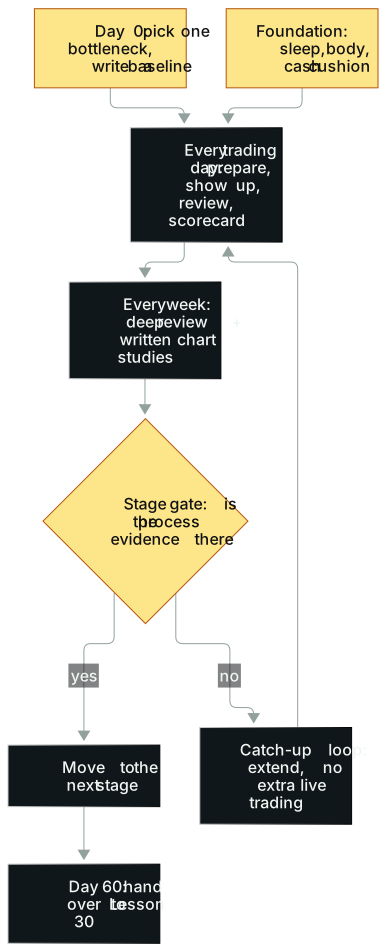
In words: (1) On day 0, pick one main bottleneck and write a dated baseline. (2) Every trading day, do four fixed actions: prepare before the open, stay fully engaged during the session, review after the close, and fill in the scorecard. (3) Every week, do one deep review plus a batch of written chart studies. (4) Split the 60 days into four stages; each ends with a gate judged only on process evidence. (5) Pass and you move on; miss and you take the catch-up loop, extending the stage without adding live trading. (6) Sleep, physical health and a cash cushion form the foundation under the daily routine. (7) After day 60, Lesson 30 decides whether to continue.
Opening: two calendars
A trader with more than a decade behind him had moved on to coaching newer traders, plus content and a nonprofit, more than a dozen threads at once. He went to a friend who advises businesses, hoping to turn trading education into a real company.
The friend didn't start with the business. He asked a question first: how did you become one of the best traders in the world?
The answer was honest. Close to obsession. Health and social life went on the back burner, and for nearly ten years almost every Sunday went to review and charts. Not talent; more than full effort. Even so, it took him about two years to start making money, and more than once he almost quit.
The friend followed up: if the younger you had been pulled in a dozen directions like you are now, how good could you have become?
He thought about it. Not at all, he admitted. It simply wouldn't have happened.
What makes the question work is that it criticizes no one. It just puts two calendars side by side. The one from ten years ago has a single item. Today's has more than a dozen boxes, each marked important. Put them next to each other and the answer jumps out. That is part of why he eventually stopped trading full-time to focus on coaching: one person can push only one thing to its limit at a time.
The 60-day plan in this lesson is the calendar version of the same idea. Most people who want to trade better start by adding things: a new strategy, a new course, a few more videos. This plan goes the other way. Cut what you do down to very little, nail the daily routine in place, and then do it for 60 days straight.
Hobby-level effort for professional-level results is a trade that doesn't balance. Trading as a hobby is fine, even worthwhile; just don't expect it to produce professional results. It's a transaction, and both sides have to match.
The idea
Inconsistency hurts more than not trying hard enough
People who have coached hundreds of traders rarely see intelligence as the reason they fail. They have watched traders who aren't especially bright make remarkable money on Wall Street. The reason far ahead of every other is failing to sustain intense, effective effort.
The typical picture: a journal kept for three or four days, then a blank week; one serious weekend review, then gone for half a month. Then the puzzled question of why nothing has changed. Everyone knows you can't learn piano or golf that way, yet plenty of people treat trading exactly like that.
The point to see is that the few days of journaling are fine. The damage is in the gap afterward. Training runs on continuous feedback, each round building on the last. Break the chain and the last round goes cold, and next time you have to warm up from scratch. Subtract the broken days and the number of training days that actually counted in a month is usually far lower than you'd guess.
So the first design rule of the 60-day plan is consistency before intensity. A plan so harsh it breaks on day four is worse than one sized just right and finished without a gap.
Judge the process
The goal of this plan is not to make money in 60 days, though that would be nice. The bigger goal is to become the kind of trader who deserves to make money.
Short-term P&L is full of noise; the work process isn't. That is the foundation of the whole plan. Over 60 days, P&L is driven by market conditions, luck and a tiny sample, and says almost nothing about whether the training worked (Lessons 1 and 26 go into this). Whether you prepared today, whether you reviewed, whether the scorecard is filled in: you can see all of that and control all of it. Execute the process well and you have won the day, whether it made or lost money.
So every promotion and pass condition in the plan hangs on things you can see and control. Hang them on P&L and you have handed the plan to luck.
Attack one bottleneck at a time
The daily scorecard habit changes a lot of professional careers, because it keeps you fixed on one question: which single problem, if fixed, would improve your trading the most? Top performers don't try to fix ten things at once.
The harsher version: list the ten most important things, circle the first, and cross out the other nine. Not because they don't matter, but because nobody can stay intense on ten things at once. The rest can wait; one at a time.
For the plan, this means spending a few hours before you start working out your main bottleneck: the one with the highest payoff relative to the effort it takes to fix. Judge three things: how big the payoff would be, how much effort it takes, and how likely you are to succeed. A useful question: if you changed just one thing, which one could double or even triple your yearly P&L?
The bottleneck moves with your level. Beginners most often struggle with stock selection, not knowing where the real action is that day. Intermediate traders most often won't size up on their best setups. At a very high level, the bottleneck becomes pushing size to the edge of your ability, or branching into other products. Whatever level you're at, that's where the bottleneck is.
Volume on the bottleneck
If you say you're practicing, how many reps? How many years of past market data have you gone back through? How many chart write-ups? Most traders are limited not by brains but by repetitions.
A ready-made format is the 30-day sprint: one goal, one metric, one behavior change, repeated at a volume far beyond normal. If the bottleneck is entries, do dozens of replay sessions watching nothing but the entry trigger. If it's sizing, set one rule set that allows no exceptions for a full month, and add dozens of sizing drills a day on top.
This isn't easy. Dozens of chart write-ups a week means several a day, three focused hours, and a brain like mush by bedtime, but progress comes much faster. Keep the distinction clear, though: this is a sprint gear, not a cruising gear. In a 60-day plan it works as a booster for one stage, not as the base pace for the whole thing.
60 days is one square
The last principle is setting expectations. Sixty days cannot turn a beginner into a profitable trader.
At top discretionary trading firms, with one-on-one coaching from profitable traders, successful new hires usually still take a year and a half to two years before they make money. Many veterans define consistent profitability modestly: not getting rich, just no longer trading so badly.
So the plan's promise is small. The rough milestones: by day 15 you notice how inconsistent you usually are; by day 30 you recognize patterns faster and progress gets more concrete month over month; by day 60 you are probably not yet a top trader, which is completely fine, but you have something more valuable: the habits of a top trader.
There is no line that reads "start making money on day 60."
The method
Day 0: choose the bottleneck, write the baseline
Spend a few hours before you start on two things.
First, choose one bottleneck. List every improvement you can think of and give each three estimates: payoff, time and odds of success. The one that scores high on all three goes first; copy the rest onto another sheet and leave them alone for 60 days. "Get better at trading" doesn't count. Write it as a visible behavior, like "I hesitate at entry and chase after price runs" or "on my best setups I only ever take half size."
Second, write down the starting point. Without one, you can't answer on day 60 whether anything changed. Use only visible things for the baseline: how many of your last few dozen trades broke your own rules; whether your calls on a batch of old charts of one setup are consistent; how many hours you sleep on average; how much time each trading day leaves you. Any numbers are fine. What matters is writing them down with a date.
Every trading day: four fixed actions
- At least 30 minutes of purposeful prep before the open. Scrolling social media or leaving financial TV on doesn't count. Know which names the market is focused on today, which catalysts are expected, and run through your A+ setups. Most important: before the opening bell, lock in the bottleneck you are working on today. If hesitation is costing you money, today is about hesitation. If sizing is the problem, every decision today pushes toward sensible size.
- Full engagement during the session. When there are no opportunities, the work turns into study. Pro athletes train when there's no big game; musicians rehearse when there's no show. The hours spent watching a series with the quote screen open could have been compounding skill.
- At least 2 hours of review after the close. Screenshot every trade, write down your reasoning at the time, and ask whether the execution matched the plan. Many traders rush to the next tutorial before learning from their own mistakes, which is the wrong order. Your own trades are material made to measure for you.
- Fill in the daily scorecard after every session. The process goals on the scorecard target your chosen bottleneck (Lesson 24 covers scorecard design).
A rough time count: half an hour before plus two hours after makes two and a half hours outside the session every trading day, twelve and a half hours over five days. Add three hours on the weekend and that's fifteen and a half hours a week outside the session, before any written chart studies.
Every week: one block of deep work, one batch of written studies
Three uninterrupted hours of deep work on the weekend. Phone out of reach, no social media. Dig into the week's charts and data and refine your strategies. With the market closed, there are no live moves to distract you and you aren't drained after a long trading day, so these hours are often the most productive of the week.
20 written chart studies a week. Not screenshots; write-ups. What the market looked like before the trade, how it should have been traded, why the move happened, where the edge was, and what size fit. Sixty days is a little over eight weeks, so at 20 a week you end up with roughly 150 to 160 studies with real content.
Twenty won't fit into three weekend hours, so spread them through the week, about four per trading day, on top of the two hours of daily review. How you schedule that is the most important step in designing the calendar. If it doesn't fit, don't add anything else, and don't quietly downgrade "written" to "screenshot."
The foundation: sleep and health
At least 7 hours of sleep a night, healthy food, some exercise every day, no alcohol. It looks like the last rule but it's the foundation for everything above it. Your brain is your most important trading asset, and trading psychology doesn't start when you open a position; it starts with how you lived the previous 24 hours. For many traders, 60 straight days of proper sleep alone would make a visible difference, just from better thinking and steadier emotional discipline.
One veteran was frank about it: force him down to 5 hours a night and he'd probably become a net loser, more than a decade of experience notwithstanding.
Four stages across 60 days
The four-stage split below is our own arrangement. Each stage has a type of output, and the gate looks at the output, not at P&L.
| Days | Focus | Output | What the gate checks |
|---|---|---|---|
| 1–15 | Get the daily routine running | Scorecards and review screenshots for every trading day | Did the routine run continuously; how many days were missed |
| 16–30 | Add volume on the bottleneck | Replays and written studies tied to the bottleneck | Has the bottleneck metric moved against the day-0 baseline |
| 31–45 | Test on unseen markets | Records of executing a fixed version, written up on no-trade days too | Rule violations; whether you followed the plan |
| 46–60 | Stability under pressure | Execution records on tired days, no-opportunity days and runs of bad days | Do the rules still hold |
You set the gate numbers yourself on day 0. Two reference formats: a set number of trades in a month with zero risk-rule violations; 20 written studies a week. Once set, a threshold can't be loosened after the fact. Miss a gate and you take the catch-up loop: make up the missing days, add no live trading, and don't raise the intensity.
More real cases
Decide tomorrow's first task before bed
A newer trader, still losing money and without a settled style, didn't tell himself he would be the best in the world by tomorrow, and set no profit targets. Before shutting down each day he picked only the first thing he would do the next morning. For example: read a small, obscure filing and see how far one stock had moved on that catalyst.
The next morning he did the thing he had picked the night before. Those small tasks stacked up day after day and eventually let him catch opportunities he'd always known existed but had no structure to capture. Traders like this keep thinking about the month's performance and their best trade after hours, so by the monthly review it's already in their heads. Without looking at a sheet they can recite their P&L, green days, red days, biggest win and biggest loss.
In the 60-day plan: leave a line under each square for "tomorrow's first task," written before bed. Small, specific, never a P&L number.
Write it up, ask, practice, ask the same person again
A young applicant first reached out to a proprietary trading firm at 18, already a year and a half into trading on his own. He wanted to practice a "second chance" scalp: a stock breaks below a range, bounces to retest the bottom of the range, then turns down again, and you take the second leg.
He practiced in four steps. When he saw someone on the desk take the trade, he first did his own review, marked up the chart and rewatched the recording to work out where he should have entered and exited. Only after writing it up did he go to the trader who took it and ask: here's what I saw; what did you see? Then he went back and practiced. The next time the setup came up and he traded it, he went back to the same person for feedback.
The part worth copying is "the same person." Feedback isn't a one-off; it's a loop. Do your homework first, have someone point out the blind spots, do it again, ask again. His application included a full month of scorecards, his trade journal and a trade-management breakdown of one PLTR trade. What gave people confidence wasn't how smart he seemed but the consistency and quality of what he did.
Buy the time first
Whether you can finish the plan depends on something that isn't on the calendar: enough money and time to last until an edge develops.
The trader from the opening, before he got into the business, worked long overtime hours at a manual job to build what he called a war chest, because he knew the learning curve often runs for years. He also chose to live somewhere cheaper. It was painful, but that money gave him freedom to pursue the career for as long as it took.
His advice to others is firm: save at least two years of living expenses, no negotiation. The stress test is simple. What if you make nothing for three to six months? What if the whole first year brings in zero? Both are entirely normal; for many people a reasonable income expectation for the first two years is still zero. Quitting your job and giving yourself six months to make the pro golf tour is nearly impossible, however hard you work.
Without that cushion, one drawdown or one bill around day 40 forces you to go "make money." Desperation is the fastest way to end the game.
A group: nobody wants to ring the bell first
New hires at top proprietary firms succeed at a rate far above the retail average. The difference isn't information but five things: community, mentors, high standards, feedback and a clear learning structure. Community works like special-forces selection: everyone wants to be the one working hardest, first in and last out, and nobody wants to be first to ring the bell and quit.
Independent traders can build one too. Two to six serious traders each keep a journal and track stats, and review together weekly or monthly. Or five people meet once a month, and each covers where they are, what they did, results, problems and lessons.
In the 60-day plan: find one person on day 0 and agree to swap scorecards every week. Keep a journal for three days and vanish on your own, and nobody notices. With two of you, someone will ask.
Common mistakes
1. Changing ten things at once. Fix entries, fix sizing, swap an indicator while you're at it, add a new strategy. Fix: attack one at a time; copy the rest onto another sheet and leave them for 60 days.
2. Doing what feels comfortable and avoiding what doesn't. The trader in Lesson 24 who spent hours in the office on weekends reading research looked dedicated, but his real problem was sizing, and his relationship with risk was built on fear. Leave that bottleneck alone and everything else is wasted. Fix: for every square on the calendar, ask whether it touches the bottleneck or hides from it.
3. Using 60 days of P&L as the report card. Over this span P&L is almost all noise. A gate that reads "make X by day 30" trains you to chase results. Fix: tie promotions to outputs only.
4. Copying extreme intensity and cutting sleep. Veterans' early effort was extreme, but many of them later stopped trading health for money. Your job and family situation differ from theirs. Fix: set the load to your own conditions; 7 hours of sleep is a hard term and can't be borrowed against.
5. Doubling up after a break. Miss five days, then punish yourself with three days at double load. That kind of catch-up rarely survives three days, then the gap gets longer, right back to the few-days-on, a-week-off pattern. Fix: write catch-up rules on day 0: miss a few days, extend by that many, with a daily cap on how much you make up.
6. Lowering quality to hit the numbers. Twenty written studies become twenty screenshots; the replay count gets done without a single line of reasoning. The numbers are right and no training happened. Fix: do fewer, rather than pad with filler.
Where this applies
- The plan is for discretionary traders with some experience who want to improve execution and judgment systematically. For developers of purely mechanical strategies, the bottleneck is often data and code, so the calendar's content changes.
- People with full-time jobs can't copy two and a half hours a day plus three on the weekend. Part-time is completely fine, but in the hours you actually have, act like a professional, and loosen your expectations about the timeline. Shorten each day and lengthen the total span, keeping all four actions but at fewer reps.
- If you're short on sleep for long stretches, in pain, struggling noticeably with your mental health or tight on living money, lower the load or pause first, and find the right support. Training can't buy its sample with live losses. Beginners with limited capital should prove an edge in a simulated account before using real money. If you can't make money steadily in simulation, real money only magnifies the weaknesses.
For FX and CFD traders, the four actions need re-timing around sessions. FX is open nearly around the clock, so "30 minutes before the open" should anchor to the session you actually trade, such as the London or New York open, not to when you wake up. Add a column for spread and overnight financing to the review; the bottleneck for days 16 to 30 may turn out to be that you only place orders when spreads are widest.
Practice: draw a 60-square evidence calendar
Materials: a 60-square calendar, your own bottleneck, your day-0 baseline.
Steps:
- Choose your main bottleneck and write it as one visible behavior, with the three estimates: payoff, effort and odds.
- Write the baseline, every item with a date and a number.
- In the 60 squares, give each one main output and one maximum time budget. Mark a review every 7 days and stage gates on days 15, 30 and 45, each with an entry condition and a failure action.
- Leave a "tomorrow's first task" line under every square.
- Write down what you do with no opportunities, your sleep floor, rest days, where the data is stored, and who your review partner is.
- Stress-test it. Assume a 5-day break, many days in a row with no setups, and a missed gate. How does the plan adjust? "Make it up with live trading" and "double the hours" are not allowed answers.
Scoring (out of 10):
- 2 points: the bottleneck is one visible behavior, with estimates and a dated baseline.
- 2 points: every square has a checkable output, all four daily actions and both weekly items are scheduled, and the time adds up.
- 2 points: every gate hangs on process evidence, thresholds are fixed in advance, and the failure action is catch-up.
- 2 points: sleep, rest days and no-opportunity days are planned, and the load is adjusted to your situation.
- 2 points: the stress test relies on neither live trading nor doubled load, and names a review partner and a data location.
Reference: a plan whose only promotion condition is P&L, or that requires a trade every day, fails outright. A packed calendar that adds up to more than five hours a day when you only have two scores 5 at most.
During training, import your records into the trade journal analyzer once a week to see how violations and the bottleneck metric move against the baseline. On day 0, use the daily loss limit calculator to set your daily cap and write it into the calendar. When you hit it, stop trading and spend the rest of the day on review.
Tools you can use
- Trade journal analyzer: split records by setup and session and compare against the day-0 baseline each week.
- Daily loss limit calculator: fix the daily loss cap for the training period so practice doesn't turn into a drawdown.
How this connects
- Upstream: the scorecards and weekly review in Lesson 24 are the originals behind the daily and weekly actions here; forward testing in Lesson 26 shapes days 31 to 45; the playbook from Lesson 28 is the book you check against in every review.
- Same thread: Lesson 20 on sleep and stress matches the foundation here; Lesson 21 on why the veteran trades so little is the same idea as attacking one bottleneck.
- Downstream: after day 60, whether to continue, pause or quit is decided with the standards in Lesson 30.
Practice this lesson in NQ Replay
Replay sessions can fill the practice blocks of the 60-day plan without putting an account at risk. NQ Replay is our own app for practicing on past NQ futures sessions, replayed tick by tick in simulation, with bracket orders, prop-style loss limits and per-trade review. You can request a free 7-day trial; you'll need your own licensed NQ tick data.
Previous and next
For educational purposes only. This is not financial advice and makes no promise of returns. Tickers, dates and market moves in real trade examples come from public sources. Individual P&L and record figures have been adjusted. Illustrative figures are the author's own. Trading involves risk of loss.
Test it in the calculator
Lock in a daily loss cap before training starts
How much can you lose in a day before you stop, so the 60 days don't turn into a drawdown?
Example (our numbers): a $20,000 account with a 1.5% daily cap, or $300, and 0.5% risk per trade, or $100. Three losing trades and you're done for the day; the rest of it goes to review.
Open the daily loss limit calculator