
In one line: right after a big loss your judgment is at its worst, so the stop-the-bleeding steps get written before the loss and handed to a system. And recovery should be deliberately slower than you want it to be.
Lesson 16 of the 30-part Trading Decisions course. By Eliza.
Lesson map
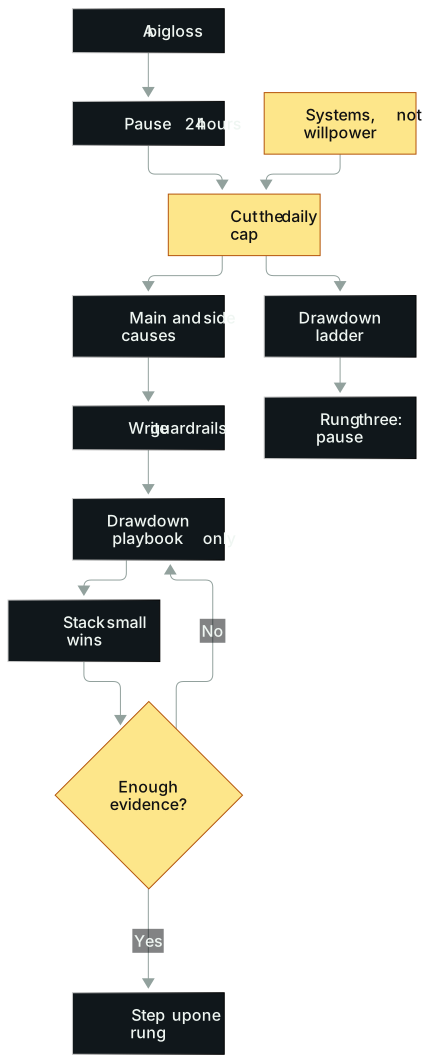
In words: (1) After a big loss, the first step is a 24-hour pause to accept that it happened. (2) Next, cut the daily loss cap right away. How far is set by a drawdown ladder written in advance: each deeper rung cuts the limit again, and the third rung means stop trading. (3) Split the loss into main causes and side causes. (4) Write guardrails against those causes. (5) When you trade again, use only the most familiar setups from a drawdown playbook. (6) Stack small wins. (7) Periodically ask whether you have enough process evidence. If yes, step up one rung; if not, stay with the drawdown playbook. (8) All of this is triggered by systems such as broker limits and software switches, not by willpower in the moment.
Opening: 1,600 shares, how bad can it get?
Ask a veteran small-cap short seller about the low point of his career and he barely pauses. There's only one.
It was a Chinese stock, ticker ZJYL, one of a group of names that got pumped. Every so often these stocks would light up with absurd volume and then lose nine-tenths of their value in a day, as if someone pulled the plug. He figured this one would follow the script, so he shorted it. Small size, about 1,600 shares, around $13.
What he was thinking: with this few shares, how much can I possibly lose?
The stock ran from 13 to about 18, hit the upside volatility limit and halted. When it reopened, the first print was 250.
He covered there. A couple of hundred dollars a share, times 1,600 shares, is a six-figure loss. It was December 2023, he had just climbed out of the previous year's slump, and this one trade wiped out a big chunk of the year. He seriously wondered why he was still doing this job. The whole thing was obviously manipulated, and the helplessness hurt more than the money.
He stepped away for five to seven weeks. The break taught him something: he still liked the work and still liked markets. With a few peers and a trading psychology coach, he went back to basics. What are the solid singles that can get me out of here? Small size, one trade at a time, and eventually the rhythm came back without his noticing.
There are two layers here. The first comes before the loss. Once a stock halts, a stop order is just paper, and 1,600 shares protects you from nothing. Size can't control that risk. Only staying away can (Lesson 9 covers this).
The second layer comes after the loss. He stopped for weeks, went back to the simplest trades, and climbed slowly instead of chasing it back with bigger size. That's this lesson.
The idea
The danger in a drawdown is losing control
A loss rarely ends a career on its own. A survivable loss becomes a spiral when it triggers revenge trades, more leverage, or pulled stops.
Good traders get flattened by big losses too. The weekend is ruined, you fall asleep with a sinking stomach, the weight is still there when you wake up, and you keep asking whether you'll get out of this one. One long-time trader counts well over a dozen serious drawdowns in his career. The upside is that each one you survive makes the next less frightening, because you know you've been here before and found the exit.
So the first goal of stopping the bleeding isn't a new equity high. It's keeping risk, judgment and execution from getting any worse.
Why deeper holes are so much harder
The math: a 50% drawdown needs a 100% gain to get back to even. Lose 80% and you need 400%. Lose 90% and you need 900%. Everyone can do this arithmetic. Very few people respect it emotionally.
Plans always look great before the first punch lands. Saying you can handle a 50% drawdown sounds tough. Living through weeks or months of it while your confidence erodes is something else, and so is the quality of the decisions you make during it. A loss big enough to wreck your confidence, degrade your decisions or damage an important relationship is nearly as harmful as blowing up. The account doesn't have to hit zero.
When bitcoin traded at 50, 60 and 70 thousand dollars, plenty of people piled in sure they could afford the risk. At 20 thousand, the hard part was answering the question at home. A safer assumption: any investment can swing two or three times harder than you normally imagine.
Willpower is weak, systems are strong
In a drawdown, you're the least trustworthy person in the room.
If watching other people post gains makes you itchy, mute the app. In trading, the three places you most need that kind of pre-commitment are the daily stop, trading while emotional, and fear of missing out.
That's also why trading firms have risk managers: someone who can stop you when you're tilted, short on sleep or fresh off a big loss, before a bad hour turns into a disastrous week. Trade alone at home and you don't have one. Broker-level limits you can't undo, plus rules written in advance, have to stand in.
Why recovery has to be slow
Nobody wants to hear it, but the fastest way out of a drawdown is to hit singles and rebuild bit by bit.
The slowest way is trying to fill the hole in one go. Someone who has lost $60,000 cuts size and starts doing math: at $800 a day, that's 75 straight green days to get back. That calculation is a trap. It makes every day carry the weight of the whole hole. The right unit is the next trade. People in a hurry to fill the hole take forever. People who fill it slowly often finish sooner.
P&L is also a lagging indicator. You skipped your daily scorecard for six months and restarted it two nights ago. The losses don't vanish. Results show up some time after the process is fixed. So don't make "how much I made back today" a recovery condition. It pushes you toward the most dangerous size.
The method
1. Ten steps after a big loss
The steps that matter most are 2, 4, 5, 7 and 9.
- Zoom out. Losing and digging out are part of the job. Sports teams often use a 24-hour rule: celebrate or sulk for a day, then back to practice. In trading, give it 24 hours and then do your best to accept the loss.
- Stop digging. Cut the daily loss cap. Depending on the damage, cut size, lower the hard stop for the day, or take a few days off. Almost every blow-up story starts the same way: no loss limit was set in advance.
- Learn from it. There are only two truly bad losses: the one you learn nothing from, and the one that takes you out of the game. Separate main causes (skipped stop, bad entry, chasing) from side causes (FOMO, tilt, no sleep) and write specific fixes.
- Install guardrails. At what drawdown do you cut size and lower the daily cap? What keeps a drawdown from ever getting big enough to damage your confidence? If you don't have this yet, build it before you trade again.
- Switch to the drawdown playbook. Only your highest-probability, most familiar setups. Singles, not home runs. For most day traders: no overnight holds, nothing that halts all the time (Lesson 17 covers this).
- Bring back good habits. Sleep, exercise, food, less alcohol, and restart the daily scorecard.
- Stack small wins to rebuild confidence. The only goal here is a positive feedback loop, not money. Take only setups so obvious they're practically in your face.
- Don't slide back. There will still be red days. The process can't break.
- Break recovery into small steps. Down $6,000? Don't stare at the whole $6,000. Think about the next $500, a green week, three days in a row without a loss.
- Avoid the despair trap. Skip the "at this size it'll take 300 days" math. Smaller size now doesn't mean smaller size forever.
Don't size up to win it back. The logic is broken. If you missed information, failed to adapt to a changed market, or have been fighting the trend, more size before you find the problem just makes the loss grow faster. A lot of people who think they're unlucky are actually trading against the trend.
"I only took high-probability setups. I didn't do anything wrong." Usually not true. If you've lost money five, ten or fifteen days running, several trades a day, and called every one of them high-probability, the math isn't on your side. You probably missed something. In a drawdown, check two things first: are you fighting the trend, and have you adapted to the current market?
2. A drawdown ladder
The guardrails from step 4 work best as a ladder. These dollar figures are our own example, there to show the structure:
| Trigger | Action |
|---|---|
| Down $7,000 | Cut the daily stop in half and switch to the drawdown playbook |
| Three losing days in a row, or down $11,000 | Cut again, to a quarter of the original |
| Another three losing days, or down $15,000 | Stop trading for at least three sessions, until your head is clear |
| Down $20,000 | Your absolute maximum drawdown. From here it takes stronger measures: a trading psychology professional, a senior trader you trust, or real time away. Come back only with tiny size or a simulator |
| Recovery | Three green days in a row, or the hole shrinks to $3,500, before stepping the limit up one rung. A more conservative version: five green days, or fully back to even |
The classic failure goes like this. Down $15,000, make a little back, still down $11,000, feel like the storm has passed, go back to full size and the old habits, and fall right back into the hole. The ladder exists so that "I feel fine" never stands in for "the conditions are met."
The structure is what matters: each rung cuts the limit below the last one, the third rung pauses, the top rung means step away and assess, and recovery goes rung by rung too. Your numbers have to come from your own historical variance and life situation.
This ladder and Lesson 14's daily, weekly and monthly caps are two sides of one system. The caps answer "when do I stop?" The ladder answers "what happens after I stop?" Day traders can add an early-warning line below the daily cap. For example, with a $2,000 cap, cut every position in half at $1,200 down, which gives you one more buffer.
3. The same ladder in R
Written in R, the ladder travels better. These four rungs are for illustration only:
- Normal: playbook setups only, up to 1R per trade, 2R daily cap.
- Caution: repeated execution errors, or rolling drawdown hits a preset threshold. 0.5R per trade, 1R daily cap, most familiar setups only.
- Protection: drawdown keeps growing, or one serious violation. No live trading for at least one full session. Coming back, test execution in a simulator or at 0.25R first.
- Shutdown: absolute max drawdown hit, out-of-control adding, or a clearly dangerous mental state. Trading access off. Assess money, process and health, and get professional help if needed.
Two rules need to be written in explicitly. First, a serious violation, such as widening a stop or trading outside allowed setups, triggers the protection rung the moment it's confirmed. It doesn't matter how much you made that day, and you don't wait for the next loss. Profit from a violation is still a violation. Second, recovery is earned with process evidence: a run of compliant trades, zero risk violations, a finished drawdown review, a fresh read on the current market. Profit can be logged. It can't be the only condition.
A worked example: after hitting protection, a trader sits out one full session, completes 12 replay samples, then takes 7 fully compliant trades in sim or at 0.25R, five wins and two losses, net +0.6R. Tiny money, better process evidence. He moves from protection back to caution, not straight to normal.
More real cases
Trying to add his way out: KBIO
A trader known for shorting parabolic runs (from Lesson 11) once shorted KBIO early in his career. It was a company close to bankruptcy, with assets worth maybe 40 cents on liquidation and only about three million shares in the float. To him it looked almost like an arbitrage. Then someone came in with a reverse merger and the stock exploded. He was short around 8,000 shares and didn't even know what a reverse merger was. As it ran to 3, 5, 7 and 10 dollars, he kept adding to the short.
His own verdict is blunt: he broke the cardinal rule, adding to a loser and hoping more trading would get him out.
It became his first six-figure loss, roughly a year's income, and he calls it traumatic. His firm was understanding and gave him room to breathe, and in about a quarter he'd dug out.
He later said the episode made him willing to take more risk. Read that carefully. He recovered inside a firm that had his back. Alone, the same logic easily becomes an excuse for more leverage.
When size is too big, your body knows first
The swing trader from Lesson 13 describes it precisely. Raising per-trade risk from a little over $9,000 to $10,000 makes him slightly tense, and he tells himself it's a new level and he can handle it. But jump an ordinary setup from $10,000 straight to $20,000 and he knows immediately it's wrong. He starts sweating in places that never sweat.
At that point you have two choices: cut size, or pray. Once you start praying, you're usually heading toward the loss you didn't want to take.
The other version is a drop in the stomach and a quiet "oh no." If you look at your position and the volume and think "if this is wrong I can't get out," the voice in the back of your head already knows. The hard part is listening. The fix is to make the action tiny: when it feels wrong, get out of a little. Cover even 100 shares of a short, like cracking a pressure valve, then 4,000, then 8,000. One veteran says that when he ignored that voice and held on anyway, he won fewer than three times in ten.
A body signal is a trigger that doesn't depend on the account, and it arrives a step earlier than the P&L.
A day off isn't quitting
The trader from Lesson 14 who posted his P&L publicly lost about $190,000 in one day after a 36-day green streak, then about $150,000 more the next day. Someone suggested a day off. His reply: he hadn't gotten here by quitting and resting, and he wasn't going to start now.
Nobody asked him to quit, though, and a day off isn't quitting. On a long streak, the "I can't break it" feeling can itself be what produces the big loss. The day after a big loss deserves extra care. Are you going to tilt? Are the protections in place? Did you learn anything? If you keep trading and keep making the same mistake, that's exactly when to take the day.
A pause is a normal state in the system. It exists to buy back judgment and has nothing to do with how tough you are.
Drawdowns hit confidence, not just the account
A small-cap trader who took an account from a few thousand dollars to seven figures in five or six years describes his worst drawdown. He was short SPRB when an upside volatility halt hit, and lost about $57,000, twice his previous largest loss. He was already up about $560,000 that year, so it was a tenth of the year's profit.
It still hit him hard. He started wondering whether the past few years had just been luck. He says that drawdown was mostly about confidence, not money. It led him to think of four accounts: knowledge, experience, money and stress. Every trade manages money risk, but it also adds to the stress account.
He got out with three things. He saw the drawdown for what it was, no worse. He reviewed what happened technically and checked whether he had broken one of his own rules. And he cut size so his attention went back to process, still showing up in front of the market every day, not necessarily trading, but present.
Common mistakes
1. Writing "make it back fast" as the recovery condition. Rushing to fill the hole is the slowest way out. Fix: recovery conditions are process evidence only, such as a run of compliant trades and zero violations.
2. Rules for stepping down, none for stepping up. Down $15,000, back to down $11,000, feels fine, back to full size, back in the hole. Fix: stepping up is staged too, with each rung's conditions written in advance (Lesson 18 covers this).
3. Letting a green day cover a violation. Profit from breaking a rule rewards breaking the rule. Fix: a confirmed serious violation triggers the protection rung, however much you made.
4. Relying on willpower. "This time I'll hold back" is the most common and least believable sentence in a drawdown. Fix: limits at the broker, switches in software, and when needed, another person.
5. Sizing up to win it back. Losses usually mean you're fighting the trend or missing something. More size before finding the cause just speeds things up. Fix: find the cause first and trade minimum size until you do.
6. Thinking a walk resets you. Drink before you're thirsty; by the time you're thirsty you're already dehydrated. Tilt works the same way. Leaving when you're seeing red and about to smash the keyboard is too late. Grade your emotions and get up at level two or three. Watch for the fake reset, too: ten minutes of pacing and swearing, then announcing you're calm. If you're still angry when you sit back down, keep your hands off the order button.
7. Copying someone else's numbers. The $7,000, $11,000 and $15,000 rungs are only an example. Yours come from your own variance, living expenses and tolerance. A high-win-rate, low-payoff strategy and a low-win-rate, high-payoff one have very different normal losing streaks and can't share a threshold.
Where this applies
This ladder fits trading where you can define 1R and can pause or cut risk. If the account carries debt, living money is mixed in with trading money, margin calls are possible, or you're no longer in a state to execute safely, adjusting size isn't enough. Stop and deal with the higher-priority problem first. Trading stress is real. A loss can be genuinely traumatic and push people into abnormal, even dangerous mental states. Close the platform when you need to, and get professional help if you need it. There's nothing shameful about that.
The framework also can't stop gaps, vanishing liquidity or platform outages. The opening trade proves it: no stop order catches a jump from 18 to 250. What it reduces is controllable behavioral decay. It can't buy the account absolute insurance.
Forex and CFDs work the same way, with two more triggers for the ladder: margin level falling below a set line, and overnight exposure into weekends and major data releases. In leveraged accounts, forced liquidation amplifies drawdowns, so stepping down a rung should cut leverage too, not just lot size.
Practice: a stop-the-bleeding tabletop drill
Material: write your own four-rung risk card. Each rung lists the trigger, per-trade cap, daily and weekly caps, allowed strategies, forced actions and recovery evidence.
Steps: run three tabletop rounds. Every answer must cite a rule written in advance. "Depends how I feel" isn't allowed.
- Your first two trades of the day are down a combined 2.2R. The hard daily cap is 2.5R, so the most you can still plan to lose is 0.3R. The third setup looks like the best of the day. What does the system do?
- During a drawdown you make 1.5R in a day, but on one trade you widened the stop. Can you step up?
- Six compliant trades in a row, still net down 0.4R. Is that grounds for recovery?
Scoring (out of 12):
- 3 points: all four triggers are specific.
- 3 points: every rung lists both the de-risking action and the recovery evidence.
- 2 points: enforcement is mechanical (broker, software, permissions).
- 2 points: profit from a violation is handled.
- 2 points: tail risk and the shutdown boundary are written down.
If the top rung has no shutdown action, or the card allows raising a limit after a loss, the exercise fails.
Reference: Round 1: only 0.3R of planned risk is left. You can take the trade only if size, expected slippage and a tail buffer all fit inside 0.3R and the rules allow it. If minimum tradable size or reasonable slippage pushes the worst case past 0.3R, it's a hard stop. "Best setup of the day" doesn't override the cap, and the usual 0.5R or 1R is out. Round 2: no. Widening a stop is a serious violation and triggers the protection rung once confirmed. Round 3: it counts as evidence that the process is improving, but whether you step up depends on the sample size and other conditions set in advance. Six trades don't promote you automatically.
Before you write the ladder, put your win rate and per-trade risk into the Losing Streak Calculator to see how long a normal losing run gets, so the first rung doesn't sit inside ordinary variance. Then use the Loss Recovery Calculator to see what each rung's drawdown takes to recover, and the Daily Loss Limit Calculator to turn each rung's daily cap into dollars.
Tools you can use
- Losing Streak Calculator: normal losing-run length for your win rate, to place the first rung.
- Loss Recovery Calculator: the gain needed to recover from a given drawdown.
- Daily Loss Limit Calculator: each rung's daily cap in dollars.
How this connects
- Upstream: Lesson 14's daily, weekly and monthly caps are the trigger lines for this ladder. Lesson 15's four cut triggers are what "step down a rung" looks like in practice.
- Downstream: Lesson 17 builds the drawdown playbook, Lesson 18 covers stepping size back up in stages, and Lesson 19 covers the revenge trading that drawdowns invite.
- Review track: Lessons 22 and 23 show how to break a big loss into causes and turn them into guardrails.
Practice this lesson in NQ Replay
Set a tighter daily loss limit in evaluation mode as your de-risking trigger, and practice trading the rest of the session at reduced size. NQ Replay is our own app for practicing on past NQ futures sessions, replayed tick by tick in simulation, with bracket orders, prop-style loss limits and per-trade review. You can request a free 7-day trial; you'll need your own licensed NQ tick data.
Previous and next
- Previous:[Lesson 15: When to Add to or Cut a Position]](/blog/when-to-add-or-cut-a-position/)
- Next:Lesson 17: A Playbook Just for Drawdowns
For educational purposes only. This is not financial advice and makes no promise of returns. Tickers, dates and market moves in real trade examples come from public sources. Individual P&L and record figures have been adjusted. Illustrative figures are the author's own. Trading involves risk of loss.
Test it in the calculator
The deeper the hole, the steeper the climb
Lose 30% and what do you need to get back to even? Lose half?
Example: a 30% drawdown needs about a 43% gain to recover, 50% needs 100%, and 80% needs 400%.
Open the Loss Recovery Calculator