
In one line: a drawdown playbook isn't a blacklist. It's a short do-list. Keep the one or two setups you know best with the smallest tails, write each one as rules, review it daily, and shelve everything else without throwing it away.
Lesson 17 of the 30-part Trading Decisions course. By Eliza.
Lesson map
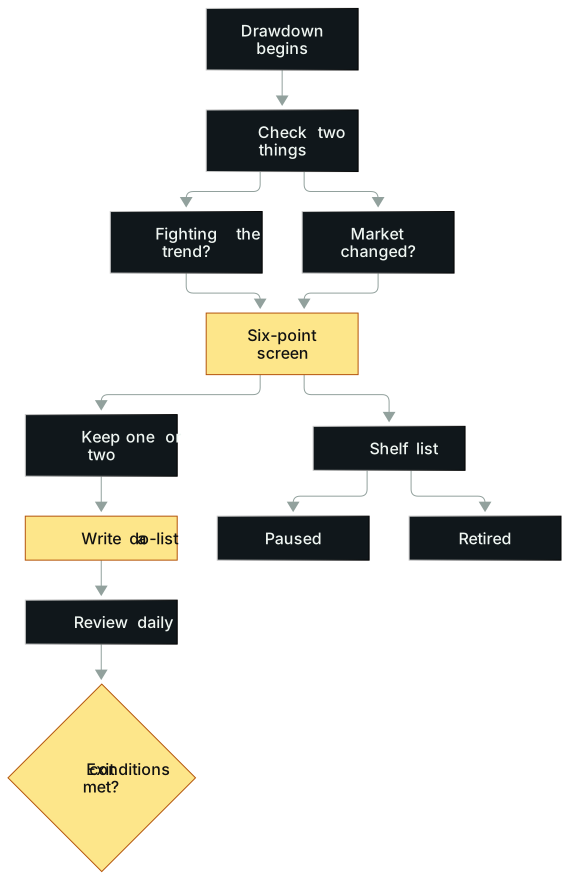
In words: (1) When a drawdown starts, check two things first: were recent losses taken against the trend, and has the market's rhythm changed while you kept trading the old one? (2) Run every strategy through a six-point screen: definition, sample, stop, environment, familiarity, tail. (3) Only one or two that pass everything go into the drawdown playbook. The rest go on a shelf list with two columns: paused, with the condition for re-review, and retired, with the reason the evidence is gone. (4) Write the kept setups as a do-list: what you trade today, where you get in, where you get out. Review it every day. (5) Check the exit conditions periodically, using process evidence only, and leave the drawdown playbook when they're met.
Opening: too much enthusiasm
Two young traders at one firm were so enthusiastic that colleagues joked they could fill a river. Ask one of them at ten at night what he was doing and the answer was: looking at charts at home.
Those two ended up in a drawdown bad enough to threaten their careers.
It had two causes. Early on they worked alongside an excellent senior trader. They got along, made good money, and shared in his risk. The trouble was that his risk was far too big for where they were, and they carried a slice of it. The rhythm was his. The losses landed in their accounts. To its credit, the firm was patient and gave them a long leash on drawdown. Plenty of firms would have cut them loose much sooner.
By the time a coach was brought in, they had lost a lot, and the realistic outcome was that the firm wouldn't keep them. The coach wasn't surprised by the timing. Most people don't ask how they could be better when things are going well. They ask after it breaks.
He started by placing them on a spectrum. At one end are traders who shoot first and ask questions later. They climb fast and fall just as fast without a foundation. At the other end are perfectionists who need a month of green days before adding a share. These two were firmly at the risk-taking end.
His approach had two features. First, he didn't hand them a list of prohibitions. He nudged them a few notches toward system: rebuild the playbook, and stop trading the front side of a move, meaning fighting a trend that hasn't turned yet or averaging down all the way. What the front side looks like, what the back side looks like, what counts as a turn, and what action goes with each all became written entry and exit conditions.
Second, the rules were almost embarrassingly plain. For example: don't buy below VWAP unless there has been an emotional, exhaustion-style flush; don't short above VWAP unless there has been an exhaustion-style spike. No code, no algorithm, just conditions written down.
The result wasn't dramatic. Their trading got only a little more systematic, and the effect was obvious. Both reviewed the new playbook every day, not once a month. Both went on to become traders making seven figures a year.
Being told what not to do doesn't make you better. Purposeful, focused practice does. A drawdown playbook isn't a blacklist. It's a do-list: for now, I trade only these things, the rules are on paper, and I go through them every day.
The idea
A drawdown is a signal that you're missing something
The most common excuse in a review is "I only took high-probability setups." But losing five, ten, fifteen days in a row, several trades a day, while calling every one of them high-probability means at least one of those claims is false. Most likely you missed something. The two usual culprits in a drawdown are trading against the trend and failing to adapt to a changed market. Start there.
That's the reason for a drawdown playbook. A long menu means a lot of variables. If five strategies are all losing, you can't tell whether one is broken, the environment shifted, or you're the problem. Cut the menu to one or two and the problem has somewhere to land. If those still lose, the issue is them, the environment, or you. If they turn green, the issue was probably in what you shelved.
Singles and home runs have different variance
In a drawdown, your psychological capacity is at its lowest. A high-variance trade at that point might just get you back to where you started if it works, and drop you another floor if it doesn't.
So the drawdown playbook has one goal: find the easiest singles and protect a "no new damage" mindset every day. Home runs are occasional. Singles happen daily, and in a drawdown you want what happens daily. The hard money, the kind that takes big risk and a lot of pain to earn, can wait.
The recovery math is unforgiving too: lose 50% and you need 100% to get back; lose 80% and you need 400% (Lesson 16). The playbook's first job is to stop the digging.
You add constraints, not new ideas
It's easy to read this as "find a new strategy during a drawdown." It's the opposite. Don't expand the playbook, don't rework your technique, don't do anything fancy.
The two traders in the opening look like they built something new, but what they actually did was add rules. Same familiar stocks, same nerve, plus conditions like "no buying below VWAP before exhaustion" that blocked fighting the move and averaging down. Every item in a drawdown playbook should already be in your regular playbook before the drawdown. It gets selected, not invented.
The method
Step 1: Check two things
Pull your last 20 or 30 losers and ask two questions of each:
- Was this against the trend at the time? That includes averaging down on the front side and "it's dropped this much, it has to bounce."
- Did the market's rhythm change while I kept trading the old rhythm?
Step 2: Ask three questions
- Which setups have my highest win rate, and how much will I risk on them?
- Which high-variance trades must I avoid?
- Where is the easiest money each day?
The third matters most. During a drawdown, all your review work should point at it.
Step 3: Screen every strategy
One row per strategy. Only strategies that pass all six get in:
| Item | Minimum bar |
|---|---|
| Definition | Written in observable terms; tomorrow's you, not knowing the outcome, can tell whether a chart qualifies |
| Sample | A recent continuous record, not a few cherry-picked charts |
| Stop | You know where you're wrong before entry and can get out on the spot |
| Environment | Today's market still produces it, not just last year's |
| Familiarity | Traded many times, not freshly learned |
| Tail | Worst loss, losing streak and slippage are all survivable |
Win rate alone will fool you. A high-win-rate setup can hide one tail loss that eats half a year of profit. Put average win and loss, max loss, losing streak, slippage and violation rate next to the win rate, and split each strategy by trend days, range days and event days.
Step 4: Write the shelf list and the re-review condition
Two things go on the shelf first: stocks that halt all the time, and overnight positions volatile enough that you can't manage the risk. For most day traders that means no overnight holds, since overnight news makes variance far higher than intraday.
Also shelve:
- setups you just learned with thin samples
- illiquid names with big slippage
- trades where you can't say where the edge comes from
- anything that only survives by averaging down
For each one, note two things: paused or retired, and, if paused, what has to happen before it gets reviewed again. Without those two lines a shelf list is just a pile of feelings.
Step 5: Write playbook entries, plus two lines
Same fields as Lesson 5: environment, preconditions, trigger, invalidation, size tier, exit, forbidden conditions, a good example, a bad example, version date. The drawdown playbook adds two:
- Why this is more controllable than your regular strategies.
- What evidence would move it out of the drawdown playbook.
Step 6: Tie it to your risk limits and daily routine
In Lesson 16's ladder, the first rung halves the daily stop, and the same day you switch to the drawdown playbook. Lowering the limit slows the bleeding. The playbook reduces where it comes from. Do both the same day.
The daily routine shrinks too:
- Review only "where was the easiest money today?"
- Bring back the habits that worked: sleep, exercise, food, little or no alcohol.
- If complacency caused the drawdown, restart the daily scorecard (Lesson 24).
- Read the playbook entries every day, the way the two traders in the opening did.
Step 7: Write down when you leave
Write the exit conditions when you enter, in process terms, not dollars. For example: a run of compliant trades, no serious violations, the current market matching the playbook setups, a complete scorecard. Profit is a reference, not a gate. Lesson 18 covers stepping back up rung by rung.
More real cases
The whole menu stopped fitting the market
The parabolic-short trader from Lesson 11 had his two best years in 2020 and 2021, better than he'd ever imagined. Early in the next year he was still near the top, with a quiet sense that it could keep going.
2022 was a persistent bear market he hadn't really lived through. He'd always assumed bear markets meant big swings and big opportunity, but this one had far less follow-through, and some of his options strategies depended on follow-through. No single loss was dramatic. Most of his menu simply didn't fit that year's tape.
His instinct was to keep fighting, so he overtraded. It took the better part of a year before he truly tightened up: paused options, cut his trade count way down, and slowly climbed out.
That's useful three ways. First, a drawdown can come from the whole menu mismatching the market, not from one incident. Reviewing only the latest loss then makes you more confused, not less. Second, you can shelve an entire category. He stopped options outright instead of re-auditing every options trade. Third, months passed between "it can keep going" and actually tightening. Writing the playbook down with triggers exists so you don't depend on noticing in the moment.
He also kept trading and home life separate, with a young baby at home, and he had enough money that he didn't depend on any one month's income. Read next to the drawdown playbook, that explains why he could cut so hard. He could afford what cutting cost.
Shelved isn't deleted
In 2022 a lot of traders clung to old playbooks and refused to change or shrink. The better move was to check item by item what had stopped working, cut trades whose edge had faded, and build new systems for the new environment. Strong traders don't wait for the market to accommodate them. They adjust to the market, and faster than everyone else.
That's the cutting half. The other half showed up years later. The way to trade the 2018 US-China tariff fight was almost the same as the 2025 tariff tape, and a skill built seven years earlier paid off handsomely in 2025. Panic-tape playbooks built during the 2020 Covid crash got used again in 2025, and momentum-long setups developed around 2021 made money in late 2025 as well.
Together those set how hard to cut. A faded edge should go now. But a playbook you worked hard to build has no reason to be destroyed. When the market returns to that state, it's still there. So the shelf list has two columns: paused, with the re-review condition, and retired, with why the evidence is gone. Plenty of people only know how to delete, and at the next regime change they find they kept nothing.
One more trap: turning a strategy into an identity. "I'm a momentum trader." "I'm a small-cap guy." If the market changes state and you don't, the identity becomes a risk. A drawdown playbook has no identity. It answers one question: which few things fit this market this month?
Climbing too fast, stuck in quicksand
After one big loss, a small-cap short seller's first instinct was to size up and win it back. The next day he made about $55,000. The day after, he lost about $80,000. That's when he called it. He dropped the brute force, went back to basics and a slow, steady rhythm, took only the easiest trades, and rebuilt confidence bit by bit. He later said it felt like quicksand: the harder he fought, the deeper he sank. By year-end he had not only recovered that loss but made seven figures on top (Lesson 18 goes deeper).
For this lesson, one detail matters. What he went back to was his easiest trades, not something new. Sizing up is the opposite of a drawdown playbook. Going back to basics is the playbook.
Common mistakes
1. Learning a new strategy to win it back. Learning needs room for error, and a drawdown leaves none. Fix: once the playbook has steadied the account, learn in a simulator or at minimum size.
2. Believing everything you took was high-probability. Insisting every trade was a good one after two weeks of red is the most common drawdown story people tell themselves. Fix: ignore the label and check for trend-fighting and failure to adapt.
3. A don't-list with no do-list. "No overnights, no chasing" still leaves you at the screen not knowing what to do, so you drift back to old habits. Fix: write a do-list that says which setup you trade after the open, where you enter, where you exit.
4. Picking the "easiest money" from memory. You remember the best few trades, not the dozens that quietly lost. Fix: use a recent continuous record, sorted by strategy, with average P&L, max loss and violation rate.
5. Bringing everything back after one green day. Still well down, feel fine, return to old size and habits, fall back in (Lesson 16). Fix: write the exit conditions in advance. One good day isn't one of them.
6. Deleting without keeping, or keeping without deleting. The first leaves you empty-handed next regime. The second turns the drawdown playbook back into the full menu. Fix: two columns, a re-review condition on every item, and actually check it when it's due.
7. Dropping the scorecard once you feel better. Most long drawdowns happen because people forget what made them successful: the scorecard lapses, reviews stop, they stop talking with peers. The simpler the drawdown routine, the more important it is to do it daily.
Where this applies
You need something to select from. If the account is new and the playbook holds one or two freshly learned setups, there's no subset to pick. Go back to Lesson 5 and build definitions and samples first.
If the drawdown is rooted in living-expense pressure, collapsed sleep, or an urge to add that you can't control, screening strategies won't save you. Deal with those first and get professional help if you need it.
For swing traders, overnight holds are the strategy, so "no overnights" doesn't transfer. Their drawdown screen looks at position count, per-name risk and exposure into events like earnings and central bank meetings.
Forex and CFD traders can cut by session and instrument: keep the one or two pairs and the one session you know best, skip the windows around major data, and flatten before weekends. In a leveraged account, the tail line should include where you'd be liquidated after a gap.
Practice: a 40-trade strategy hearing
Material: your last 40 consecutive trades. If you don't have them, adapt this lesson's cases: treat the short seller's 2022 menu (options strategies, parabolic shorts, everything else) and the two traders' original approach as separate playbooks. Any field you can't fill gets "no data." Don't make it up.
Steps:
- Sort the 40 trades by strategy and environment. One row each: sample size, average P&L in R, worst single loss, slippage, violations, exit difficulty, one good example, one bad example.
- Keep two categories at most. Give each three sentences of evidence, with no "it feels" or "it's always been good."
- Give every other category a shelf reason, marked paused or retired. Paused ones get a re-review condition and date.
- Write a full playbook entry for one kept setup, including the two extra lines.
- Hide the outcomes on 8 charts of that setup, judge them blind the next day, then check.
- Write one rule in the form "unless A happens, don't do B" that can be checked in real time.
- Write three process-based exit conditions with no dollar amounts.
Scoring (out of 15):
- 3 points: categories cover all 40 trades, from a continuous record rather than screenshots.
- 3 points: average P&L, max loss, slippage and violation rate are all there, not just win rate.
- 3 points: every keep or shelve reason says what evidence would overturn it.
- 3 points: the playbook entry is complete and blind calls match the answers; where they don't, fix the definition, not the answer.
- 3 points: exit conditions are all process evidence, with psychological and life red lines that must be handled first.
Using "easiest money" instead of a sample, writing the exit in dollars, or allowing one green day to restore everything is a fail.
Reference: a solid drawdown playbook usually has one or two entries, each under half a page. More than three categories usually means you couldn't bring yourself to cut. If the tail column is empty for every category, you haven't recorded your worst losses yet.
While screening, put each category's win rate, average win and average loss into the Expectancy Calculator to see what's left after slippage. Then run the kept setup through the Losing Streak Calculator to see how many losses in a row are normal, so ordinary variance doesn't get mistaken for failure.
Tools you can use
- Expectancy Calculator: compare strategies' expectancy after costs.
- Losing Streak Calculator: estimate normal losing-run length for the setup you keep.
How this connects
- Upstream: Lesson 16 slows the bleeding before you build the playbook. Lesson 5's playbook entries are the full set this is a subset of. Lesson 6's no-edge zones feed the shelf list.
- Downstream: Lesson 18 takes over at the exit and steps size back up. Lesson 21 covers days when nothing in the playbook qualifies. Lesson 24's scorecard is the daily drawdown routine.
Practice this lesson in NQ Replay
Run only your drawdown-playbook setups on a block of unplayed sessions, and see whether they hold up before you need them live. NQ Replay is our own app for practicing on past NQ futures sessions, replayed tick by tick in simulation, with bracket orders, prop-style loss limits and per-trade review. You can request a free 7-day trial; you'll need your own licensed NQ tick data.
Previous and next
For educational purposes only. This is not financial advice and makes no promise of returns. Tickers, dates and market moves in real trade examples come from public sources. Individual P&L and record figures have been adjusted. Illustrative figures are the author's own. Trading involves risk of loss.
Test it in the calculator
Decide what stays by running the expectancy
Your highest win-rate setup: is it still profitable after the worst loss and slippage?
Example: Setup A wins 62%, averages 0.8R won and 1R lost: +0.12R. Setup B wins 45%, 2R won and 1R lost: +0.35R, but with longer losing runs.
Open the Expectancy Calculator