
In one line: goals aren't the problem. The problem starts when a goal sets your size. Rewrite outcome goals as process actions you can judge by the close, write your early signals and hard stop in advance, and take the account number's hook apart.
Lesson 19 of the 30-part Trading Decisions course. By Eliza.
Lesson map
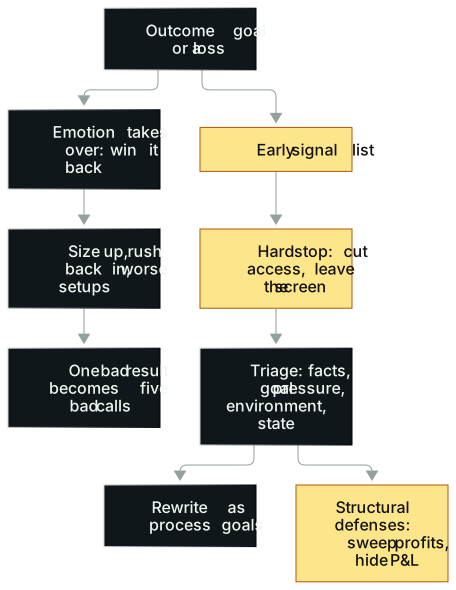
In words: (1) There are two starting points: an outcome goal (this month's number, what this trade "should" make), or a loss you just took. (2) Left alone, emotion takes over and becomes "win it back," followed by sizing up, rushing back in and taking worse setups, until one bad result snowballs into five bad decisions. (3) The place to cut the chain is the front end: write your early signals in advance, and when one shows up, hard stop, cut live access and leave the screen. (4) After the stop, triage in four columns: facts, goal pressure, strategy environment, personal state. (5) Then do two things: rewrite outcome goals as process goals you can judge before the close, and weaken the hook structurally, for example by sweeping profits out of the account regularly and not watching other people's P&L intraday.
Opening: this one owes me seven figures
The small-cap short seller who keeps coming up in Lessons 16 through 18 had a good habit: when he made money, he moved it out of the account. Then, during the wild tape around 2022, with Bed Bath & Beyond and GameStop taking turns ripping, he had an idea. Reset the account to a few tens of thousands of dollars and see how fast he could get it to seven figures. He did it in under two months. The account multiplied several times in the first month alone.
What he was thinking: this is the year I become a big trader. Trade a seven-figure account, keep every dollar in.
There was one pattern he hadn't caught once during that run: the liquidation-style collapse in Chinese small caps. Pumped first, heavy volume, then after the first limit-down halt the selling cascades until the stock is down around 90% and trading for cents. Not long after the streak, TOP set up the same way. He put a number on it: this trade makes seven figures. He remembers it as the most confident moment of his career.
He shorted big. But this one didn't behave like the others. After hitting limit-down, price didn't keep falling. It held a higher low, started reclaiming, and broke the high of the day.
At that point his trade logic was dead. The plan was to enter when price hit limit-down and kept dropping. What he was looking at had nothing to do with the plan, and the normal move was to stop out. He didn't. He added. It hit limit-down again, held again, chopped sideways for four or five hours, and he kept adding. The position grew bigger than any winning trade he'd ever had, on a stock where he was losing money.
About ten minutes before the close, it hit limit-up, from around $15 to $20, with a high near $21. He knew he was done. When trading resumed it ran to 30, then 40, and he stopped out piece by piece on the way up, finishing between $40 and $50. He lost about $350,000 that day. The next day the stock hit $300. Had he still been holding, the loss would have been eight figures.
His later summary, roughly: the moment you feel most invincible is the moment your guard is thinnest. He'd broken every one of his rules that day.
Notice the order. The number existed before the loss did. Seven figures, this trade owes me. The goal pushed the rules aside first, and the loss came after. The two days of sizing up to win it back were covered in Lesson 18.
The idea
When a goal goes bad
Outcome goals aren't bad in themselves. Wanting a seven-figure year, or wanting to clear six figures first, can make you think bigger and practice harder. That's good. The trouble is a very thin line. Once a goal crosses it, it stops being a healthy habit and starts tearing your trading apart.
A senior trader explained that line with the gym. One year he set a bench press goal a little above his previous best, about 4 or 5% higher. All year it helped him. He kept sleep and diet tight, dropped a few kilos, and was stronger than ever.
With a week or two left in the year, inflammation in his shoulder was getting worse. He should have rested, and he noticed he wasn't. The only reason was that year-end was an arbitrary deadline sitting in the back of his head. So he asked himself: why does it matter whether I hit this in December, January, February or next year? Then he dropped the deadline, rested two weeks, wrote a four-to-six-week plan, and hit it early in the new year.
The test is practical: does the goal improve your process? If it does, it's a friend. If it makes the process worse, like training on a shoulder that hurts, it's doing damage.
In trading it goes bad in two directions. You set a number in January, you're only halfway by October, and you start taking absurd risk. Or you hit it in July and coast for five months. One raises your standards, the other lowers them, and in both cases a calendar and a number are making your decisions.
One bad result becomes five bad decisions
Poker players have a saying: one bad outcome snowballs into five bad decisions, because you stop thinking in probabilities and start thinking in emotions. Poker calls it tilt. Trading calls it revenge trading. Same thing.
Many of the biggest losses don't come from bad analysis. They come from someone trying to erase the discomfort of the last trade.
The first link usually looks like this. You just got stopped out, and the stock immediately goes the way you expected, as if the market was gunning for your stop. So you rush back in, at a worse price, with bigger size and sloppier judgment. One controlled loss has now become several.
The chain runs because the pain of a loss gets treated as a debt that should be "paid back." The market doesn't owe you anything. It doesn't know who you are or how much you lost on the last trade, and probability doesn't care how frustrated you are. The only thing that changed is that you're now deciding in a much worse mental state.
Knowing isn't doing
If you already know you revenge trade after a big loss, asking an AI to write a twelve-page report on why you shouldn't probably won't help. You already know.
Information was never the bottleneck. What helps is spotting the earliest signs that you're losing emotional control, cutting size automatically when certain triggers appear, enforcing a daily stop, and walking away from the desk before decision quality slides. The method section turns those into actions.
The most dangerous moment is after a win
The small-cap trader from Lesson 16, who took a few thousand dollars to seven figures over five or six years, once shorted Avis Budget Group (CAR) after its manic top and landed one of the best trades of his career. The big win brought overconfidence and carelessness. The next day, on another stock with a far worse setup, he gave back almost all of it.
TOP sits on the same line: right after a big streak, at peak confidence, the rules go first. Outcome attachment has two doors. Far from the goal, you chase. Close to it or just past it, you feel invincible. Guard both.
The method
Step 1: Rewrite outcome goals as process actions
Keep goals, but each one has to meet two conditions: you can tell whether you hit it before the close, and it has nothing to do with the day's P&L.
Common ways to rewrite:
- "Stay calm while trading" is too vague. What does calm mean? What usually sets you off? How do you avoid it? Sometimes the emotion is itself a signal. Ask one more question too: on the days you executed well, was it because you planned ahead, just came back from a break, or exercised that morning? If you don't know why, you can't repeat it.
- You don't control what the market offers. You control your daily input. So write goals as daily actions: how many charts, at what time, reviewed with whom.
- Judge a day with three questions. Did I learn something? Did I improve my trading? Did I get better at anything? Whether the day closed red or green often just says how the market happened to move, not how well you did.
- When someone keeps breaking rules, the root is often a profit number in their head rather than "all I have to do is follow the rules."
Examples:
| Outcome goal | Process goal |
|---|---|
| Make 5R this month | This week, trade only two defined setups and write each trade's risk before entry |
| Win back yesterday's loss today | Stop at the daily limit today and finish the review before the close |
| This trade makes seven figures | Write this trade's invalidation before entry, exit when it's hit, never add |
| Stay calm while trading | When the "I'm swearing at the screen" signal appears, leave within two minutes |
Step 2: Write down your early signals
A marathon runner who waits until dehydrated to drink has already taken the damage. Tilt works the same way. By the time you're furious, it's too late to calm down. Act before it reaches ten out of ten.
Every prop floor has a keyboard smasher: mutters first, slams the desk a few minutes later, then breaks the keyboard. Every stage had a warning sign. Nobody wrote them down.
One senior trader's signal is swearing at himself, or muttering about who on earth is on the other side of this trade. He used to grind on until he truly lost it and paid in P&L. Now, the moment he notices, he leaves the screen, goes outside, gets some sun and air. And if his state hasn't reset, he doesn't sit back down, because he'd be the same person the second he did.
Two other kinds of signals are common:
- Physical. Sweating, weak hands, a racing heart. That's your body telling you you're doing something wrong. Most traders ignore it.
- Frustration. Irritation, "why isn't this working yet." That usually means the timing is wrong, not necessarily the idea. Really good opportunities tend to jump out at you without any forcing.
Write down three to five of your own signals, as specific as possible. "Not feeling great" doesn't count.
Step 3: Hard stop, then cool down
When a signal appears or you hit the daily limit, do three things:
- Cut live trading access and don't discuss the next opportunity. Lesson 14 covers setting the daily limit. Lesson 16 covers forced de-risking.
- Leave the screen. Don't use a new trade to soothe what the last one left behind.
- Give the emotion an exit with a deadline. Win or lose, take 24 hours to be happy or upset, then come back to "how do I get better?" Worry by itself never becomes action.
One trader described his worst day. He lost big on a biotech stock, blew through his daily limit, logged off and walked home. On the way he passed a homeless man whose cardboard sign said, in effect, that the day you think is the end of the world would count as a good day for him. He thinks of that sign after every bad trading day. Everyone could use a reminder like that.
The day after a hard stop, don't lift it because "I've calmed down." Lift it on the conditions you wrote beforehand.
Step 4: Triage in four columns
After the stop, write four columns:
- Facts: time, ticker, what you did, how much you lost.
- Goal pressure: what number and what date were in your head.
- Strategy environment: were you trading where you have no edge, and has the market changed (Lessons 6 and 7)?
- State: sleep, mood, any outside stress lately.
Only after those four do you rewrite goals. Then be a goldfish. You learned the lesson, found the fix and installed the safeguard. Stop chewing on it. The tuition is paid.
Step 5: Take the hook apart structurally
The hook is the number in your account. Three ways to weaken it:
- Sweep profits out of the account. For individual traders this may be the strongest single defense. Pick one approach: withdraw everything above a preset account size; withdraw 30% of the month's profit at month-end; or after a new equity high, withdraw half of whatever is above the old high. Money inside the account and money outside it feel different. Moving it out builds a firewall between the speculating you and your long-term finances. A smaller balance sometimes even improves decisions, because you stop unconsciously guarding a pile of open profit and the identity attached to it. The trader in the opening normally swept profits regularly. The TOP trade happened right when he'd stopped.
- Hide P&L numbers. Skip other people's P&L screenshots and highlight reels entirely. Only consume content you can learn rules from.
- Don't let fixed costs balloon. The cases below show why.
More real cases
Avis: trading a number, not a chart
In 2021, a senior trader wanted to set his firm's record for individual annual profit. He'd already made eight figures that year and was a short distance from the target. In early November, Avis Budget Group went parabolic on electric-vehicle news, and he thought: this is the one that breaks the record. His position was far too big, and he lost seven figures in about forty-odd minutes.
His reflection afterward: only then did he realize he hadn't been trading the chart at all. He'd been trading an arbitrary number he had set himself, which the market couldn't care less about.
Lesson 22 takes that trade apart in full. Here, take one point: the goal set the size first, and the chart was just there for decoration.
Crypto has an even more extreme version. In the altcoin crash of October 10, 2025, a whale who had publicly announced an enormous profit target got liquidated on leveraged positions, losing tens of millions of dollars.
Trying to win back $9,000 in one shot
A small-cap day trader who shares his trading publicly said something very honest. When the horse throws you, you want to climb right back on. Second trade, another loss. Now you're grasping at straws: do I take a third? Three strikes is baseball's rule. Why wait for the third?
One day he was down $9,000. His thinking was that if he could just make back the $9,000, it would stop hurting. So on the next stock he put on 45,000 shares and made 20 cents a share, getting back to flat. But he'd also done the math. He could lose 5 to 10 cents of slippage getting in and another 5 to 10 getting out, so if the trade had gone the other way his loss for the day would have doubled in a blink. He'd tracked himself, too: once past his max loss line, about three times out of four, the loss went on to double.
What's worth noting is that he studied his own data and knew when he was most likely to lose control, while most people only study charts. Even so, he needed a hard daily loss limit built into the system more than a soft rule like "don't lose more than a good day makes."
Study your own breaking point and write it down as a number. Data like that can become a hard-stop rule directly.
The account's peak becomes "my money"
Another kind of attachment is harder to see. Someone runs an account from six figures to a few million in an extraordinary market, then gives back 30 or 40%. Objectively he's still very successful, but he feels like he lost a fortune. That peak got filed in his head as "my money," even though much of the gain came from an unusually friendly environment, or was only open profit. Now every trade is tied to getting back to the high, and he gets more reckless.
Stock prices carry the same anchor. A stock that once traded at $80 feels cheap at $30, even when the fundamentals changed long ago. The market doesn't care what it used to cost.
The cure is Step 5: move money out. What you've withdrawn no longer counts toward "the high I have to win back."
This trade has to pay for diapers
The small-cap trader from Lesson 16 spent a stretch supporting his family entirely from trading. He later called it the worst decision he could have made, because it put him in survival mode. This trade has to make rent. Then his daughter was born, and it became: this trade has to pay for diapers. He stopped watching setups and process and watched only results. That's where he went wrong.
Outside pressure is one of the most damaging things for a trader. It forces you to do something instead of waiting for the right trade.
Good markets produce the same thing in a different costume. In 2020 and 2021 plenty of traders raised their fixed costs. When the market cooled in 2022, every decision came with a "must make money" flavor.
Both versions share one feature: outside spending turns into a number you must hit every month, and the landlord and the bank set the goal. Drawdown playbooks, ladders and daily limits can't reach it. It has to be solved outside the account.
The best day becomes a keyboard-smashing day
A story goes around prop shops. An excellent trader caught a breaking news headline and had the best day of his career. He was ecstatic and sure he was number one at the firm. Then he found out someone else had traded the same headline bigger and better, went straight from euphoria to smashing his keyboard, and announced he was quitting.
A veteran who sat among a hundred-plus traders for years noticed that his deepest slumps always came when he felt worse than the people around him. After he went independent, the comparison pool just grew from one room to the whole internet. His fix was to block out other people's trades during the session and talk with peers only after the close.
Common mistakes
1. Thinking understanding is enough. "I know revenge trading is bad" has never stopped a single order. Plenty of people understand a concept completely and still can't execute it for months. Write it as signals, actions and who enforces them.
2. Throwing out every goal. Goals motivate. That bench press goal kept someone disciplined all year. The test is whether the goal improves process.
3. Reflecting only after you've lost control. You can only change the front of the chain. By links four and five, emotion is already in charge. Write the signal list when you're in good shape.
4. Using a lucky profit to justify a violation. Money is a reward, and rewards train behavior (Lesson 1). Break a rule, get paid by luck, and the next violation comes easier. Fix: log it as a profitable violation and deduct points on the scorecard.
5. Making "calm" a goal. Calm is a result, not an action. Break it into triggers, signals and an exit action.
6. Thinking winning days need no defense. TOP happened at peak confidence. The giveback after the Avis short came the day after the biggest win. Good stretches are exactly when to double down on process.
Where this applies
These methods fit traders who have rules, a daily limit, and a way to tell before the close whether their process was compliant.
If losses have already caused a traumatic response, such as persistent insomnia, depression, intense despair or an inability to stop, course exercises aren't enough. A loss can be a genuinely traumatic event. Log off when you need to, and get professional help if you need it. There's nothing shameful about that. How people react to losses is often tied to their relationship with money, and sorting that out does more than switching strategies.
If your income depends entirely on trading with no cushion, goal pressure never goes away. Fix the money structure first, not the mindset techniques.
Forex and CFD accounts add two traps. Markets run around the clock, so "leave the screen" has to include closing the trading app on your phone. And leverage is high, so one revenge add can put your liquidation price right next to the market. Write into the hard-stop rule that after the limit is hit, you open nothing new that day and don't add to or move stops on existing positions.
Practice: a goal-contamination fault tree
Material: use the TOP case from the opening as the worked example, then do the same for your own most recent impulsive trade.
Steps:
- Write your three current outcome goals and answer three questions for each: what process was it meant to help? What signal shows it's hurting the process? What rule kicks in automatically?
- Draw a five-node fault tree for TOP: trigger (the seven-figure target and the under-two-month streak), interpretation (this trade owes me), action (no stop, adding), immediate reward (four or five hours of chop while he kept hoping it would turn), consequence (about $350,000 lost).
- Draw the same five nodes for your own impulsive trade.
- Design a guard at each of the two earliest nodes, each with an action and an owner. For example: hide the monthly gap on your intraday screen; broker locks the account at the daily limit; tell a peer in advance and give them the right to make you stop. "Stay calm" is not a guard.
- Rewrite each of the three outcome goals as a process goal you can judge before the close.
- Write five early signals of your own.
Scoring (out of 15):
- 3 points: the constructive use of all three goals is written out, with no blanket rejection.
- 3 points: the signals that show harm to the process are specific and observable.
- 3 points: the fault tree is complete and shows how deadlines, identity or outside spending changed your interpretation, not just "I lost."
- 3 points: both guards are executable, with an action and an owner.
- 2 points: process goals can be judged the same day and are independent of P&L.
- 1 point: a psychological safety boundary is written, including when to seek professional help.
Any answer that allows adding size to close the gap to a goal fails.
Reference: in the TOP tree, the earliest node to cut is the trigger. The moment a goal reads "this trade makes X," it should be swapped for "what invalidates this trade?" The next earliest is the action. Price holding a higher low and breaking the high of day is the plan being invalidated, so the pre-set rule should be "invalidated means out, never add," enforced by the platform's daily lock.
Put your account size and per-trade risk into the Daily Loss Limit Calculator to get a limit that trips before you tilt. Then use the Loss Recovery Calculator to see how much the account would need to gain if a loss past the limit doubled. That number is the best argument for a hard stop.
Tools you can use
- Daily Loss Limit Calculator: turn the hard stop into a specific dollar amount.
- Loss Recovery Calculator: see what gain it takes to recover a doubled loss.
How this connects
- Upstream: Lesson 1 covers how making money can still be a violation, and this lesson explains why that kind of profit is so addictive. Lesson 14's daily, weekly and monthly limits are the edge of the hard stop. Lesson 16 covers de-risking after the stop.
- Parallel: Lesson 18 handles the urge to fill the hole fast on the ladder. Lesson 20 covers the sleep, stress and attention behind the signals.
- Downstream: Lesson 22 takes apart the Avis trade in full. Lesson 24 scores each day with process goals.
Practice this lesson in NQ Replay
Take a planned loss in replay and watch the next few minutes: the urge to win it back shows up in simulation too, where it costs nothing. NQ Replay is our own app for practicing on past NQ futures sessions, replayed tick by tick in simulation, with bracket orders, prop-style loss limits and per-trade review. You can request a free 7-day trial; you'll need your own licensed NQ tick data.
Previous and next
For educational purposes only. This is not financial advice and makes no promise of returns. Tickers, dates and market moves in real trade examples come from public sources. Individual P&L and record figures have been adjusted. Illustrative figures are the author's own. Trading involves risk of loss.
Test it in the calculator
Turn the hard stop into a number
On a $40,000 account, what daily loss limit shuts the door before you tilt?
Example: a $40,000 account with a 1.5% daily limit stops at $600. Risk $200 a trade and three straight losses lock you out, with no fourth trade to win it back.
Open the Daily Loss Limit Calculator