
In one line: your state doesn't decide where the market goes. It decides whether you can execute your rules today. Score sleep, stress and attention before the open, map the score straight to cutting risk or stopping live trading, and only ever adjust downward.
Lesson 20 of the 30-part Trading Decisions course. By Eliza.
Lesson map
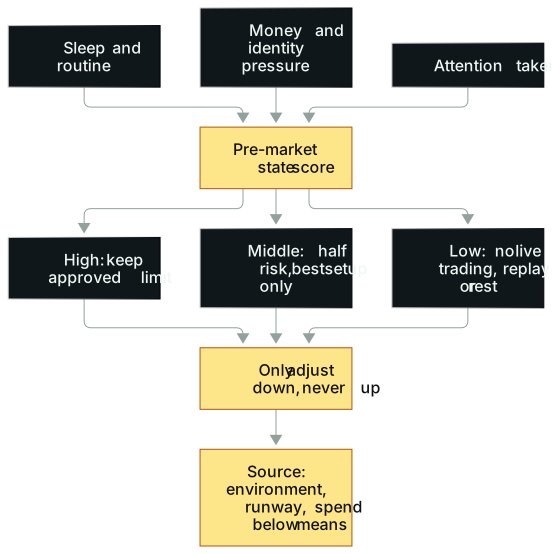
In words: (1) Three drains: sleep and routine, pressure from money and identity, and attention taken by phones and news. (2) Before the open they add up to one state score. (3) The score maps directly to permission: a high score keeps the risk limit you approved in advance, a middle score halves risk and allows only your most familiar setup, a low score means no live trading, just replay or rest. (4) The rule only adjusts downward. However good you feel, you don't exceed the approved limit. (5) At the source, environment design replaces willpower, and runway plus spending below your means keep money pressure out before you ever enter a trade.
Opening: the 3 p.m. beer
During the 2020 lockdowns, two traders worked side by side in one of their apartments. Big sushi orders at lunch, a hot market, a genuinely good time.
It started small. After a tense day, with an hour to go before the close, both of them were running on fumes. Someone suggested a cold beer. It's only three o'clock. Sounds harmless. A few days later, the beer had a shot next to it. A few days after that, it was two or three drinks, and both were a little buzzed going into the close.
Then one day, one of them took a closing-imbalance trade right before the bell, lost, and went completely quiet. The other one glanced over and knew. After the silence, the one who'd lost spoke first: we can't keep doing this. The other agreed. It had gotten a bit out of hand.
Their takeaway was plain: if you don't rein yourself in, the market will do it for you.
Nobody in this story made a dangerous decision. Each step was only slightly bigger than the one before, and each had a reasonable-sounding excuse. Tired. Good market. Not that much. A slipping state moves in slow motion, and the person inside it is usually the last to notice. The market ran their pre-market check for them. It just billed them rather bluntly.
This lesson is about running that check yourself, before the market does.
The idea
State governs execution, not the market
Your edge answers "is this kind of opportunity worth taking?" State answers a different question: can the person sitting at the screen today actually execute the rules? Keep those two ledgers separate.
A bad night's sleep doesn't make the market harder. It changes you. You react half a beat late, miss a rule, and want the last trade back more. The same chart that looks like a B setup when you're rested looks like an A setup after a night of no sleep.
A good analogy: trading while emotionally compromised is like driving after drinking. Sometimes you get home fine. Do it often enough and one night you won't.
One more comparison worth keeping. When the account loses, you can wire money in. When your head loses, there's nowhere to wire from. Calm can't be topped up like margin. So risk management starts before the opening bell. Sit down tired, tense or scattered and your error rate is probably already noticeably higher than normal. There's no precise figure for "noticeably." Treat it as a reminder not to wait for the losses to tell you your state was off.
Performance is one system
You can't have a blowout fight with your partner over breakfast, or scrape your car on the way in, and then expect to trade as if nothing happened.
Plenty of "I don't know what happened today" stories start long before the first entry: short sleep, a late start, something at home. Review only the charts and you'll never find the cause, because the cause isn't on the chart.
Three drains
Split the sources into three, because each needs a different fix.
- Sleep and routine. Easiest to measure, first to be sacrificed.
- Money and identity pressure. "If this doesn't work I can't make rent" and "if I'm not driving a sports car by thirty I'm a failure" look different and work the same way. Both turn every trade into life or death.
- Attention taken. Phones, social media, markets that never close, half an eye on another account.
They feed each other. People who sleep badly get pulled around by headlines more easily, and people pulled around by headlines sleep worse. Check them together, treat them separately.
Why grinding through gets addictive
Forcing trades on bad-state days sometimes makes money. That's the worst part. The market rewards bad behavior often enough to train it.
The math is simple. If on bad-state days you trade well only one or two times out of ten, then most of those days you should be sitting out. One senior trader, looking back, said it took him close to a decade to really learn this. Tired, hungover or sick, he'd tell himself to push through. Occasionally that worked. Overall, those days ate a large share of his profits.
Lesson 1 covered why making money while breaking rules is the most dangerous outcome. Forcing trades in a bad state and getting paid is the same danger: the money teaches you to force it again.
The best night of a career, and nobody wanted to celebrate
Lesson 10 walked through the entries and exits of the night of the Nikkei panic, August 5, 2024. Here we only look at the trader's body.
He'd just finished an endurance race that weekend and nearly didn't log in. After he built the position, the open profit shot up, then gave most of it back in one go, with price almost returning to his invalidation point. He'd been awake for more than twenty hours by then, drenched in sweat, heart pounding. All he could do was follow the invalidation he'd written in advance. Price didn't break back down. The open profit grew into the millions, and he started scaling out.
When it was over, he didn't celebrate. He was hollowed out, his brain felt cooked, and he'd barely slept for two days. He counted it among the best trades of his career, and also said that walking away from the screen, what he mostly felt was: that was awful. Later, asked whether he wanted to chase a new record, he said that if he was really getting better, the goal should be to never need that kind of exposure again. In his year-end review he logged those days as a health overdraft. The market will always be there. Your body won't, not in the same way.
That trade made money, but it isn't this lesson's role model. It's this lesson's warning. Even someone with more than a decade of preparation got through that night only because the rules were written beforehand. Someone without rules, in the same physical state, would most likely have ended up somewhere very different.
The method
Step 1: Run a state check before the open
Do it at a fixed time before the open, as one line on your daily scorecard. Ask yourself:
- How did I sleep? Did I wake up clear or heavy?
- Am I tired or distracted? Sick, hungover?
- Is my mood steady? Is anything outside trading weighing on me?
Be ruthlessly honest. Your judgment may already be discounted at this point, and the easiest conclusion to reach is always "I'm fine today."
Then score it. Some traders grade A to F and call it a temperature check, with a sleep tracker's score as one input and their own feel counting just as much.
Step 2: Map the score to a risk action
An example A-to-F mapping:
| Pre-market state | Risk for the day |
|---|---|
| A, B | Keep approved base risk |
| C | Halve risk per trade |
| D | Keep 30% of risk, best single setup only |
| F | No live trading; research, replay or recover |
The numbers vary by person. What matters is that the table was written the day before. There's an even blunter version: after a very bad night, don't trade at all and do some other productive work instead.
If you don't have a scale yet, start with this 8-point version (our own, not a medical standard):
- Score four items from 0 to 2: sleep window (did you give yourself an unbroken stretch of rest?), recovery on waking (obviously tired or foggy?), stress load (how much work, family, travel or losing streaks are stacked up?), attention (drifting, missing rules, refreshing P&L?).
- 2 means normal for you, 1 means a slight deviation, 0 a clear one.
- 7 to 8: keep base risk. 5 to 6: halve risk, most familiar setup only. 4 or below: no live trading.
There's nothing magic about the cutoffs. They're valuable because you set them while you were thinking clearly.
Run the numbers. A $30,000 account at 0.5% base risk is $150 per trade. Today you scored 6, so you halve it to $75. With a 60-cent stop, that's 125 shares instead of the usual 250. Put the number on your pre-trade checklist and there's nothing left to negotiate in the moment.
Step 3: Only adjust down
Make the rule asymmetric. Good state: keep the approved limit. Bad state: cut.
Experienced traders often pre-write a few tiers on their scorecard: small size on quiet days, base size on normal days, larger on days with unusually rich opportunity. After a great night's sleep on an active day, one might use the higher tier, but that's choosing among tiers written long before. Nobody breaks through the tiers because they feel especially good today.
If you're still building your rules, only use the downward half. Leave the upward half until you have more than a year of records.
Step 4: One goal a day
From about ten minutes before the open, enter a focus block and put the phone in a drawer. Write one goal for the day on the scorecard. Just one, the one with the most impact on your performance, such as "don't force trades against the trend."
Attention is limited. Ten goals means none.
Step 5: Environment before willpower
Whatever runs on willpower doesn't last many days. The steadier move is to change the environment so bad options become a hassle:
- After a set hour in the evening, the phone charges on the balcony or by the door. Using it means walking over.
- No quotes before you've seen daylight in the morning.
- No phone or laptop in the bedroom, no stressful email or markets in the last few hours before bed.
- No snacks in the house, so when you're hungry the only options are healthy ones. Leave a weighted backpack by the door. If you nearly trip on it on the way out, you might as well put it on.
Discipline is like a muscle: a little every day and it grows. It also comes from controlling your environment. The goal is doing it right 80% of the time, not perfection.
One line to draw clearly: this lesson only covers how to turn state into trading permission. It doesn't tell you how many hours to sleep, what to eat or drink, or whether something is wrong with your body. Persistent insomnia, pain, heart palpitations, low mood, or an urge to trade you can't control are things for a qualified doctor or counselor. When the device score and your body disagree, trust your body and stop.
Step 6: Solve money pressure before you enter
Think of it as a barbell. One end is the risk in your trading. The other end is every financial decision outside it: lifestyle, spending, investing, debt. Together they can't exceed what you can lift. If the trading end is already heavy, the other end has to be light.
Three concrete rules:
- Spend below your means. One senior trader said the best thing he ever did was keep his spending far below his income from his early twenties on. He never once had to trade under pressure from his personal finances.
- Build runway. Work out how long you might go without making money, then fund that stretch in advance.
- Don't let a small stock-picking account eat your attention. Trying to look clever by picking stocks usually means underperforming, losing time, and tying up emotion. Put long-term money in plain index funds and cash and let it sit quietly.
What the three have in common: no single trade in your account should decide whether you make rent next month.
More real cases
Pulled into trading on vacation
In 2024 a senior trader went to Japan with a few trader friends. Everyone was watching screens, and he got pulled in. He took a short, got stopped out, and lost a large amount, in the seven figures.
His later verdict on the trade: you're abroad, sleeping badly, on vacation, and you shouldn't be trading at all. Taking a loss like that on top of it feels especially bad.
The most useful detail for this lesson: you can't see it on his yearly P&L curve, because he made all of it back and then some the next day.
The totals erased it. It doesn't exist on the spreadsheet. It existed in his state. Review by results only and it gets filed as a "minor bump," and the three conditions (bad sleep, vacation, no plan) never make it into the facts column. Lesson 22 returns to this: the facts layer of a review needs a state record.
Manual labor, roommates and two fast-food meals a day
Before he started trading, the same trader spent several years doing manual work to save money. When he joined a prop firm, he shared a place with several roommates, paid three or four hundred dollars a month in rent, ate two fast-food meals a day, splurged on a few sushi rolls and a beer, and picked the cheapest gym around.
It took him more than two years to start making money consistently. In his words, without those savings he never would have lasted that long.
The word he used was runway. He knew he might go a long time without earning, so he bought that time in advance. What it bought him was two years of thinking about only one thing every day: how to trade better, not next month's rent.
The value of this case is that it turns "pressure" from a mood into something you can purchase ahead of time. Runway doesn't buy comfort. It removes one interfering variable from every trade. Lesson 14's daily, weekly and monthly risk limits are the other half of the same idea.
Turning an office into a distraction-free zone
In 2020 this trader ran one of his firm's offices. That year was packed with opportunity and called for his best performance. He'd read a book on habit formation the year before and decided to design the environment seriously: phones out of reach, every removable distraction removed, more positive cues around, the whole office set up to be focused and smooth-running.
That year he made eight figures in trading profit in a single year for the first time, and gave a large share of the credit to the environment, because it kept him in flow for longer.
He didn't call it the only reason. The 2020 market was great on its own. It's here to show a direction: he didn't rely on "I'll focus harder today." He relied on moving the distractions out of the room.
Common mistakes
1. Linking one bad night to one trade's P&L. A sleepless night followed by a losing day is coincidence, not proof. In Japan, the first badly slept day lost seven figures, and the second, equally badly slept day won it back. You need dozens of days of samples, which is what the two-week exercise below is for.
2. Sizing up because the device score is high. The device is one input, not a switch. If the score is high and your body keeps feeling wrong, trust your body.
3. Changing many things in one week. Change sleep, diet, training and size all at once, and whatever happens next, you won't know which one did it. Add one thing at a time.
4. Treating persistent discomfort as a discipline problem. Ongoing sleep or mood problems can't be fixed with rules. Pull your trading permission first, then get professional help.
5. Thinking big-opportunity days earn an exception. On the Nikkei night, that trader did make an exception. His preconditions were more than a decade of preparation, an extremely rare setup, and knowing in advance exactly where he'd be wrong. He himself said the next goal was to never need that exposure. Treating his exception as a template turns the exception into a rule.
Where this applies
The state check governs whether you can follow your rules during the session. It does nothing for the 3 a.m. anxiety of overnight positions. One trader left his old firm partly because overnight positions wrecked his sleep: he'd wake up wired, check the market, and never fall back asleep. Position size itself belongs in Lessons 13 and 14.
Someone else's sleep protocol is built on their body, their test results and their habits. Copied onto yours, it drifts. This lesson keeps only the layer that turns a score into an action.
US equities are moving toward 24-hour trading, and wild moves now show up on weekends and late at night. A lot of traders are still struggling with that. Answer one question in advance: how big would a weekend opportunity have to be for you to trade it, one that might make $1,000, or one that might make $10,000? Set that bar before Friday. You won't set it well at 3 a.m. on Saturday.
Forex and CFD markets are open nearly around the clock, which makes these rules matter more, not less. "No live trading" has to become a concrete action: log out of the trading app on your phone, or set a daily loss lock on the platform. If you trade across time zones, fix your session hours in writing, and don't drag yourself out of bed because London just opened. In a high-leverage account, one groggy order can put you a few pips from your liquidation price.
Practice: a two-week state and permission log
Materials: one sheet, ten consecutive trading days. Fill in half before the open and the other half after the close. Live or replay both work.
Before the open: the four state scores (0 to 2), the total, today's permission (keep, halve, no live trading), and whether any hard-stop signal is present (can't stay alert, repeatedly missing rules, an uncontrollable urge to place orders).
After the close: rules missed, impulse orders, number of trades, whether you held to the permission set before the open, and how difficult the market was (your own rough grade).
On day ten, answer only three questions:
- Which state signal most often shows up on the same day as an execution slip?
- Could that pairing be explained by something else, such as market difficulty or strategy type?
- Which single permission rule will you keep watching next cycle?
Don't start any other health experiments during the log. You may write "occurred together." You may not write "bad sleep caused the loss."
Scoring (out of 12):
- 3 points: all ten days logged. A low-score day with no trades still gets logged as "the permission rule worked," never left blank.
- 2 points: permission set before the open, not filled in after.
- 2 points: hard-stop conditions written clearly.
- 2 points: at least one counterexample (bad state but compliant execution, or good state but a violation) and at least one confounder.
- 2 points: no medical judgments, and P&L not used as a measure of sleep.
- 1 point: when to seek professional help is written down.
Any answer that uses the device score as a diagnosis, or uses a good state to exceed the approved risk limit, fails.
Reference: a passing log often reaches a conclusion like this one. Over ten days, three days scored 5 to 6, and on two of them the stop rule was missed. But those two were also the two messiest market days, so market difficulty can't be ruled out. Next cycle, keep one rule only: at a total of 6 or below, trade only the opening-range breakout. Notice that it draws no causal conclusion. It just keeps one rule that can be tested further.
Put today's account size, the reduced risk and your stop distance into the Position Size Calculator to get the downgraded share count directly. Then use the Daily Loss Limit Calculator to lower the day's loss limit on low-score days as well.
Tools you can use
- Position Size Calculator: after a state downgrade, size from the new risk amount.
- Daily Loss Limit Calculator: set a lower stop line for low-score days.
How this connects
- Upstream: Lesson 14's daily, weekly and monthly risk limits set the ceiling on permission, and this lesson downgrades beneath it by state. Lesson 16's damage-control rules are the drawdown version of the same "worse state, less permission" idea.
- Parallel: Lesson 19 covers outcome attachment. Lesson 21 covers doing nothing, and a failed state check is its state gate.
- Downstream: Lesson 22 adds a state record to the facts layer of a review. Lesson 24's daily scorecard turns the pre-market state check into a fixed column.
Practice this lesson in NQ Replay
Note your sleep and stress before each replay session, then line them up against the decision scores in your review. NQ Replay is our own app for practicing on past NQ futures sessions, replayed tick by tick in simulation, with bracket orders, prop-style loss limits and per-trade review. You can request a free 7-day trial; you'll need your own licensed NQ tick data.
Previous and next
For educational purposes only. This is not financial advice and makes no promise of returns. Tickers, dates and market moves in real trade examples come from public sources. Individual P&L and record figures have been adjusted. Illustrative figures are the author's own. Trading involves risk of loss.
Test it in the calculator
Downgrade your state, resize the trade
Your state only supports half risk today. How many shares is that?
Example: a $30,000 account at 0.5% base risk is $150 a trade. Halved for a low score, it's $75. With a 60-cent stop that's 125 shares, not the usual 250.
Open the Position Size Calculator