
In one line: sitting out isn't laziness, and it isn't proof of discipline either. Run every candidate through four gates. When one fails, write which gate, why, and what reopens it. In review, sort flat days into compliant waiting, fear avoidance and no preparation.
Lesson 21 of the 30-part Trading Decisions course. By Eliza.
Lesson map
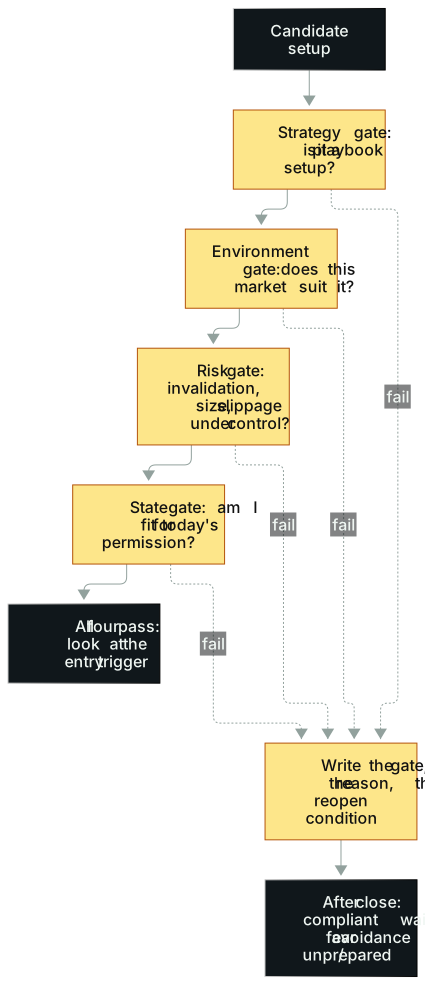
In words: (1) Every candidate goes through four gates: the strategy gate (does it fit a specific setup in your playbook?), the environment gate (does the current market suit that setup?), the risk gate (can invalidation, size, slippage and tail risk stay inside your limits?), and the state gate (are your attention and mood good enough for today's permission?). (2) Only if all four pass do you look at the entry trigger. (3) If any gate fails, write down which one, why, and what condition would reopen it. (4) After the close, sort the flat day into one of three types: compliant waiting, fear avoidance, or no preparation.
Opening: a whole year, about eight weeks of real trading
In 2024, a senior US equities day trader posted the best result of his career, well ahead of several already very good years. In his year-end review he opened a spreadsheet and broke out P&L by theme and by product. The report began by stating one thing: that year, there were only about eight trading weeks that really mattered.
Those eight weeks included SMCI, MSTR, bitcoin and the moves around the US election, plus the August panic in Japan, the best single trade he'd ever made (Lesson 20 covered what it cost his body). Everything else? He hadn't traded buy-sell imbalances in years, hadn't done ultra-fast breaking-news trades in years, hadn't touched IPOs in years. The day-in, day-out singles he used to hit, he'd dropped entirely. He no longer sat in front of six monitors every day. Much of the time he was outside, walking, doing something else.
He broke the reasons into four. First, experience: he'd studied and taught A+ opportunities for many years and had them well honed. Second, means: plenty of buying power and the flexibility to trade many products, international markets, options, overnight. Third, a stage of life that let him take on a meaningful dollar risk. Fourth, luck: that year's environment fit his style unusually well, with liquid events and clustered opportunity.
Then he added two "don't copy me" notes. One: if next year's opportunities come mainly from real-time news, low floats or IPOs, all of which need someone sitting at the desk, he'll lag badly, because he doesn't trade them. Two, for intermediate and especially beginning traders: don't risk money that matters to you. Build repetitions. What works for him won't automatically work for you.
This story often gets read as "trade less and make a fortune." That's a misreading. He didn't say sit around. He took only A+ opportunities and dropped several categories outright, and he could name every one of them: buy-sell imbalances, ultra-fast breaking news, IPOs, small daily gains. For him, "not trading" had names.
This lesson is about making sure every time you're flat, it has a name, a reason and a way back in.
The idea
Sitting out protects three things
Risk budget, attention and optionality. A trade with no edge doesn't just risk money. It eats the judgment and emotional stability you had left for the rest of the day.
On high-volatility days that shows even more. Don't spend risk budget on junk. What's worth waiting for is the poker equivalent of pocket aces. In practice: don't burn the daily loss limit early, don't fight the trend in the first half of the move, and don't hold dumb overnight positions that eat tomorrow's risk budget. Nobody wants to get locked out by the daily stop at 10 a.m. and then watch the real move happen that afternoon.
At the poker table, folding is the job
TV makes poker look like everyone shoving all-in. In reality top players throw away the large majority of their hands. Folding constantly is most of the game.
Trading's distribution is even more skewed. Passing on hundreds or thousands of patterns a day is normal, and for top traders, a small handful of trades producing most of the year's profit is common. Two trades in a day is fine, with no guilt, as long as they're the two with the highest expectancy. Better to do nothing for three hours and then press hard on an excellent setup than to cobble together twenty mediocre ones out of boredom.
Trading even has an advantage over poker. Poker charges blinds: cards or no cards, you bleed every orbit. In trading, waiting patiently usually costs nothing.
The colleague with the short playbook
That trader had a colleague of more than a decade who came in with no background, followed the path laid out for him to the letter, turned profitable within the first few months, and over the following years made eight figures in total. Asked how to make the most money as early as possible, his answer surprised people: sit on your hands more, and be pickier about what you trade.
His playbook was very short, and he swung only when the pitch landed in his zone. Trading less and trading steadily built confidence, almost like a self-fulfilling prophecy. Only later did he use the profits to learn new strategies and add them to the book.
The trader used himself as the counterexample. Back then he tried to learn everything at once, so of ten skill levels he got each skill only to level two, and learned slowly. If he did it again, he said, he'd copy his colleague and focus on one or two strategies.
Doing nothing is often harder than trading
People are wired to act, especially the ones drawn to markets: ambitious, competitive. Sometimes the hardest thing is sitting still.
Intraday momentum traders hit stretches where nothing moves cleanly, or setups suddenly stop following through. Forcing active trading then just donates money to the market through commissions, frustration and fatigue. The alternative is research mode: review the tape, study historical patterns, refine the system, log mistakes, clean up watchlists, test ideas. Discipline isn't only the ability to execute trades. It's also the ability not to trade when conditions are against you.
If you can't state your edge, you don't have one
In sports betting and prediction markets there's an extreme rule: if you can't articulate your edge, you don't have one. If you can't quantify expectancy, you're guessing. If you're out of your depth and the odds are against you, you can always get up and leave. For most people, not participating is the highest-expectancy move available.
The stock market is positive-sum, and brokers want you to grow, make money and trade more. Sports betting is negative-sum, and once you're flagged as a winner, you get limited. One veteran said the biggest edge he ever built wasn't a setup, a model or a strategy. It was knowing which games not to play.
Three faces of being flat
They look the same from outside. Inside they're completely different.
- Compliant waiting. The candidate was evaluated, you can say which condition wasn't met, and the reopen condition is written down.
- Fear avoidance. The setup fully qualified and you didn't pull the trigger. That's a problem to work on, and Lesson 19 has the method.
- No preparation. No playbook, no idea what counts as an opportunity, so you did nothing. Go back to Lesson 5 and write setup definitions first.
Reviewing a flat day means sorting it into one of these three.
The method
Step 1: Four gates
Before any entry decision, every candidate goes through four gates.
- Strategy gate. Does it fit a specific setup in your playbook? If all you can say is "looks like it'll go up," the answer is no.
- Environment gate. Do trend, range, events and liquidity suit this setup? The same chart isn't equivalent across environments (Lesson 7).
- Risk gate. Can invalidation, size, slippage and tail risk stay within your limits? When you can't define the loss, not participating is itself the risk action.
- State gate. Are your attention, mood and execution quality good enough for today's permission? A bad state means even an A-grade chart doesn't automatically qualify (Lesson 20).
Only when all four pass do you look at the entry trigger. If any gate fails, "no trade" isn't enough. Write the reopen condition: wait for price at the range edge, wait for the event to land and reprice, wait for volume to come back, wait for your state to reset. That one line turns waiting into a rule with an exit. Without it, waiting is just open-ended procrastination under a nicer name.
Step 2: Set expectations low before the open
One professional trader's habit: before the open, look at the macro backdrop and estimate the odds of an outsized move today versus an inside day (high and low both within yesterday's range). If it leans toward the latter, he reminds himself to expect little, prepare for the worst case, and treat anything good as a bonus. When the market really does go sideways, he isn't caught off balance.
On some days breakeven is a win, and not trading is a win.
Signs of a low-opportunity day: few names come out of your intraday and daily scans, little breaking news, lots of names chopping in ranges, the summer lull, an approaching holiday.
Step 3: In high volatility, take it in pieces
In a tariff-shock week where everything is happening at once, the rhythm is: take the big swings in pieces, be careful with overnight exposure, and don't let yourself get locked out by the daily stop. Overnight holds are very tempting, and veterans get burned too. Once, a trader was sure SPY would keep going after a big up day. Overnight, tensions involving China escalated and it gapped down hard the next morning. Afterward he didn't stop holding overnight entirely. He held less and watched tail risk more closely.
Step 4: Prepare scenarios on the weekend, don't marry a view
On the first weekend of August 2024, around 7 p.m. Eastern on Sunday, QQQ futures were already down about 1.4%. Lots of people spend the weekend building plans, but several batches of new information still arrive before Monday's open: Sunday evening futures, overnight single-stock trading, premarket, and only then the regular open. The Nasdaq could just as easily open higher, and then every plan built around a panic is useless.
So use the weekend for two things: prepare scenarios, don't lock in an opinion. Build a buy list for a gap-down open, going ticker by ticker starting with VIX. Study similar past opportunities and decide how you'd trade those setups. The plan should answer: how much risk to allocate, what pattern you want to see, what would confirm the thesis, and which trap you fall into most often.
That's another use of waiting: you're waiting for information, not for price.
Step 5: Slow for whom?
Next time "there's nothing today" crosses your mind, ask a sharper question: is the whole market slow, or only slow for my playbook?
One exercise works well. After the close, ask: what was the best opportunity today? A lot of people say the market was slow and come back with two trades. Don't settle on an answer until it clearly improves. Spend three or four hours looking and a few trades that make you slap the desk often turn up. They may not be in your playbook, but they tell you the slowness was in your scan, not the market.
Step 6: Review flat days too
Save screenshots at twelve points across the day (see the exercise). At each, write: candidate setup, four-gate result, reason for not trading, reopen condition, and whether it later triggered. After the close, sort the day into one of the three types. If rules are so narrow that you get no samples for a long time, adjust them during a fixed review slot, never by loosening them mid-session.
More real cases
GME: great hole cards, ugly flop
Here is the GME chart from Lesson 6's opening (May 9) from a different angle. On the daily, GME strengthened from May 2, printed a big up candle on May 3, then a string of inside bars coiled into a wedge with a low around 15.30 and a high around 17.25. Working back from a 50-cent risk, the trader in that story bought around 16.10, right in the middle of the wedge.
A senior trader's read: the daily pattern had a lot of potential, like being dealt ace-king. But the hand's potential isn't everything. You also need to see how the flop comes, your position, stack sizes, how the others have been playing. That day's intraday action was like holding ace-king and seeing a suited 9-7-6 flop. A promising hand suddenly isn't so great, and you have to adjust. He kept watching the daily, but no intraday setup satisfied him, and he especially disliked the failed breakout that dropped back to the lows. He didn't trade that stock in either direction that day.
The value here is how the pass was written. His "no trade" had a name: daily qualified, intraday development didn't, price sat mid-range, and neither risk nor reward was clear. He also left a way back in: a breakout above the daily wedge, consider long; a break below, consider short; and if holding a short, definitely cover on an upside break. He added a more important warning: don't let a string of small stops grind you out before the real breakout shows up.
The November everyone called dead
In November 2025 the consensus was that everything was slow. Yet one professional trader later called it his best month of the year: shorting quantum-computing names and holding, a few longer swings, some bounces and mean reversion, and a Palantir short followed by the bounce. What he regretted most was the reversal Nvidia's earnings set off across the market. He handled that one poorly, or the month would have been even better.
His explanation was groupthink. Everyone says it's slow, positioning gets slow too, and when a great opportunity suddenly appears, people react too late, unprepared. Another veteran added a contrast: in 2024 and 2025 there was no market that was slow across the board. Something somewhere was always in a bull run: crypto, low floats, futures, frothy bubble stocks.
It's here to hold one line. Sitting out needs a reason, and "everyone says it's slow" isn't one. Your reason has to come from your playbook and your scans, not other people's mood.
Last day of the month, no news
Another professional trader faced the last trading day of a month: no news, a short week. Before the open he estimated the odds of a big move versus an inside day, as usual, and told himself to expect little. He finished flat and was completely fine with it.
The senior trader alongside him described his own shift. He used to trade millions of shares a day. On days with nothing going on, he now trades close to zero. It took him years to truly internalize that not trading can be a win.
Read it next to the previous case. On a slow day, one trader went looking elsewhere, the other lowered expectations to breakeven. Both were right, and for the same reason: before the open, they'd already decided what would count as a qualifying trade.
Leaving the desk by 11 on slow days
A young but already seasoned trader wrote in his annual review that it wasn't worth being wound up all day, at the cost of his health, for days that swing a few thousand dollars either way. He set himself a rule: on slow days, leave the desk before 11 a.m.
A veteran's comment had two layers. For him, reasonable: he has the experience and data to make that call. For beginners and developing traders, these days still call for being present, first to build experience, and second in case major news or a setup appears out of nowhere. There's a weighty extra reason: tail events account for a large share of P&L. If you're still developing, stay at the desk as much as you can and don't throw away those reps.
The same action is a trade-off for someone with lots of samples and a lost practice day for someone without them. Your rules for sitting out should follow your stage.
Common mistakes
1. Treating no orders as good discipline. A day with no orders and nothing logged is just a day with no orders. Fix: screenshot every candidate and write one line per gate.
2. Treating boredom, chat-room buzz or a daily P&L target as a strategy condition. "I haven't hit three trades yet" isn't a strategy condition. Fix: no minimum trade count, only a maximum.
3. Chasing after missing it. All the optionality you saved by waiting gets spent in one chase. Fix: include "if missed, wait for the next trigger" in the reopen condition.
4. Loosening conditions mid-session. "Reopening" becomes a rationalization tool. Fix: rules only loosen during a fixed review slot. Mid-session they can only tighten.
5. Switching strategy after a flat streak. A week with no opportunities: first check the environment, whether your scan is too narrow, and whether the sample is big enough, before changing strategy. Same question: is the whole market slow, or only for your playbook?
6. Grading a pass by what happened later. "It dropped afterward, so skipping was right" earns nothing. Fix: judge the quality of a pass only on conditions visible at the time.
Where this applies
This lesson assumes you already have a playbook and can say what counts as an opportunity. If the playbook isn't formed yet, doing nothing doesn't help you learn. At that stage you need Lesson 5: write setup definitions, then build samples with replay.
Stage matters too. One trader later shifted to swing trading plus selling options, stopped spending ten hours a day glued to screens, traded only his best few setup types, and found his profits didn't suffer. That trade-off cuts both ways. The upside is not making dozens of decisions an hour, maybe only one or two important ones a day. The cost is carrying overnight gaps: you can wake up to a stock already down 20%, and with overnight exposure it's harder to switch off mentally. Neither style is better. What matters is finding the timeframe that suits you.
One more thing: a seasoned trader's flat days were bought with tens of thousands of samples. For someone still collecting samples, a flat day is precisely a lost practice day. Bridge the gap between protecting risk budget and keeping your practice volume with simulation, replay and small size.
Forex and CFD markets barely close, which makes the "there's always something" illusion stronger. Add one item to the environment gate: is this the session when your instrument is most liquid? EUR/USD during the Asian session, or an index CFD around a Friday-evening data release, can have spreads and slippage that eat an already thin edge. If you can't state your edge for this session, close the platform.
Practice: twelve waiting points
Materials: a replay of one full trading day, yours or any case in this lesson. Save a screenshot at fixed intervals or at every candidate until you have twelve points.
At each point, write five things:
- Candidate setup: which playbook setup it's trying to be.
- Four gates: strategy, environment, risk, state. Pass or fail for each, with one line of reason for a failure.
- The reason for not trading, citing observable conditions.
- The reopen condition.
- Whether it later triggered.
Wrap-up: pick two points to dig into. For one, show how waiting protected risk. For the other, check whether fear made you miss a fully qualified trade.
Scoring (out of 12):
- 2 points: all twelve points complete.
- 3 points: every waiting reason cites observable conditions.
- 2 points: reopen conditions are specific, with a price level or an event.
- 2 points: at least one impulse source identified (boredom, fear of missing out, wanting it back).
- 2 points: compliant waiting is distinguished from fear avoidance.
- 1 point: no decision graded by later P&L.
Answers like "it dropped afterward, so skipping was right" score zero.
Reference (the GME day): the candidate was an intraday breakout on a daily wedge. Strategy gate: daily qualified, intraday development didn't. Environment gate: the breakout failed and returned to the lows. Risk gate: a 50-cent intraday stop was too tight; switching to a daily swing would put the stop below 15.30, over 80 cents of risk, with an unclear target and odds. State gate: no information. Reopen condition: a daily breakout that holds on a retest, or a daily breakdown whose bounce fails. Classified as compliant waiting overall.
Put the win rate and average reward-to-risk of last month's filler trades into the Expectancy Calculator and set them beside the numbers for your best playbook setup. Then use the Trade Journal Analyzer to split results by setup and see whether everything outside the playbook, added up, made or lost money.
Tools you can use
- Expectancy Calculator: compare per-trade expectancy for mediocre and strong setups.
- Trade Journal Analyzer: split P&L by setup to find the trades you shouldn't have taken.
How this connects
- Upstream: Lesson 5's setup definitions and exclusion rules fill the strategy gate. Lesson 6's no-edge zone is what the environment gate blocks most often. Lesson 20's state check is the state gate.
- Parallel: Lesson 19 covers outcome attachment. Fear avoidance while flat gets handled there.
- Downstream: Lesson 22's review template includes flat days. Lesson 24's scorecard turns "was the wait compliant?" into a column.
Practice this lesson in NQ Replay
On a slow replayed day, count the times you wanted to click without a setup; skipping them is a skill, and replay lets you practice it. NQ Replay is our own app for practicing on past NQ futures sessions, replayed tick by tick in simulation, with bracket orders, prop-style loss limits and per-trade review. You can request a free 7-day trial; you'll need your own licensed NQ tick data.
Previous and next
For educational purposes only. This is not financial advice and makes no promise of returns. Tickers, dates and market moves in real trade examples come from public sources. Individual P&L and record figures have been adjusted. Illustrative figures are the author's own. Trading involves risk of loss.
Test it in the calculator
Price out your boredom trades
How much expectancy separates a trade you forced out of boredom from one you waited for?
Example: a mediocre setup at 45% win rate and 1.1 reward-to-risk has about -0.06R expectancy before costs. A strong setup at 40% and 3:1 is +0.6R. Twenty of the first don't add up to one of the second.
Open the Expectancy Calculator