
In one line: finding the cause is only half the job. Every improvement passes three gates: see it, rewrite it, lock it. A fix should let an observer tell whether you did it, and a guardrail should be more trouble to cancel than to follow.
Lesson 23 of the 30-part Trading Decisions course. By Eliza.
Lesson map
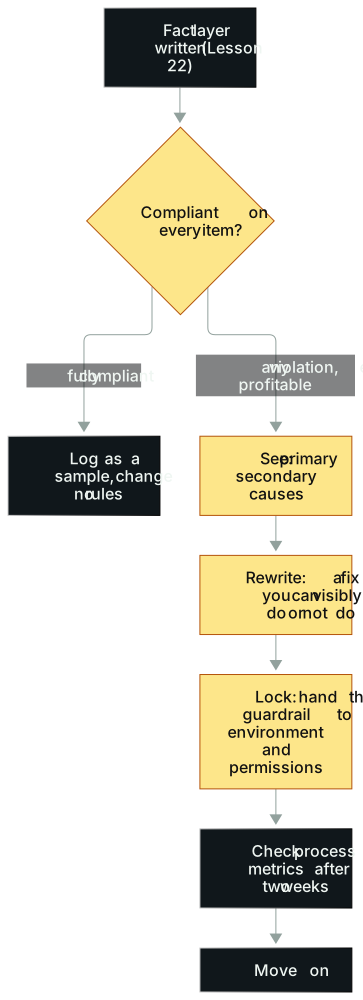
In words: (1) Start from the fact layer you wrote in Lesson 22 and check compliance item by item. (2) A fully compliant loss goes into your sample, and no rules change. (3) If anything was violated, even on a winning trade, keep going: separate the primary cause from secondary ones. (4) Write a fix for the cause that an observer could see you doing or not doing. (5) Lock the fix into your environment and permissions, so it becomes a guardrail that doesn't depend on willpower in the moment. (6) Check it against process metrics after two weeks, then move on.
Opening: "Oh well"
A senior trader once did a show where he read trade reviews from his community out loud. They were submitted voluntarily. He hadn't read or picked them in advance.
One came from the summer of 2026. The author graded his day a B+. His goals for the day were sound: wait for clean setups, and be faster and more decisive at the breakout point.
His best trade was Micron (MU). Price broke below the opening range and he shorted, only 60 shares instead of the planned 100, and made about $540. Then came this line: I meant to trim half, hit the wrong hotkey and flattened the whole position. Oh well.
Most readers would skim past it. The senior trader stopped: no, you don't get to just say "oh well."
"Oh well" is quick and easy to write. But it was sitting on top of two unaddressed improvements.
The first was the hotkeys. The key to trim part of a position and the key to flatten it all were too close and too similar. Could he move one, or put a modifier-key combination in front of the flatten key? The second was re-entry. A liquid name like Micron has limited slippage. If it was still a good trade when he got flattened by accident, why not get back in at the right size?
The second trade was QBTS, a gain of a little over a hundred dollars. The author wrote that he should have been much bigger, bought only 400 shares, but oh well. The senior trader: there's that phrase again. He guessed it was a verbal habit. If every time it came out it set off a small alarm, okay, let me question that assumption and check again, then the habit itself could become a tool.
The review got an A-minus overall. Two deductions: no daily chart, and the reflection didn't go deep enough. The summary: good coaching helps you find your blind spots. This trader had taken the first step and noticed the problem. The next step is squeezing every bit of value out of that observation, and that step is a lot of what separates top traders from everyone else.
"Oh well" is a period at the end of a review. Write it and the case is closed. This lesson is about not closing the case so fast.
The idea
Finding the cause is only half the job
Many traders spend time working out why a loss happened, then stop there and skip the step that matters most: coming up with a fix. Posting loss screenshots online does nothing to make you better. You have to identify the mistake, propose an effective fix, and work out how to implement it fast. That's the difference between people who grow quickly and people who stay stuck.
Posting a loss screenshot is a bit like posting your medical test results. Lots of likes. You're still sick.
Every improvement passes three gates
- See it: write the facts clearly and rank the causes.
- Rewrite it: turn the cause into a specific action whose completion is visible.
- Lock it: use environment and permissions to hold that action in place, so it doesn't depend on your emotions in the moment.
A common loss-recovery process maps onto these three gates: write the review while memory is fresh, propose a fix, then build and enforce a guardrail. A brilliant fix you never execute is worth nothing. This work is neither fun nor easy, which is why most people skip it, and why the ones who do it pull ahead.
Rank the causes
Lesson 22's Avis trade broke into three layers. The setup was fine: the reversal playbook that made money all year. The size was wrong, and the key mistake wasn't execution. Why was size wrong? An outcome goal had stepped into the sizing decision.
Each layer calls for a different fix. The setup layer needs no change. At the size layer, the fix is "go smaller next time." Only the third layer reaches the root: the annual P&L goal is not allowed to take part in sizing. Stop at the second layer and the seed of the next big loss is still in the ground.
Profitable rule breaks are more dangerous than losing ones
Lesson 1 made the point: breaking a rule and making money is the most dangerous outcome there is. Every experienced trader has a story like this. You ignore your rules, chase a move, and somehow it pays. Beginners celebrate money like that. Professionals are a little embarrassed by it.
The classic example is holding a position past your risk limit and getting paid. The harm is that it emotionally reinforces the wrong behavior, and in the long run that behavior will come back to bite you.
The method
Step 1: Save the evidence, then let emotions settle
Don't run this process while angry, deeply negative or rattled. Take a walk, get some air, or take a real break.
That doesn't conflict with "while memory is fresh." The order is: save the charts, orders and timeline first, so the evidence is preserved. Write the judgments once your emotions have come down.
Step 2: Write the facts with a set of questions
Lesson 22 covered how to keep interpretation out of the fact layer. Here are questions that help:
- Did you capture both the intraday and daily charts?
- What happened? How did you feel before, during and after?
- What was the market environment: were momentum breakouts working, or was it dead?
- Was this trade in your playbook? Which category? If not, what made you take it?
- Were you fighting the trend?
- Did you follow your system and risk limits? If not, why?
- Secondary factors: fear of missing out, poor sleep, chasing a daily P&L target, overconfidence after a win streak.
Step 3: Triage by compliance
"There's nothing at all to learn or improve from this trade" almost never happens. It's equally true that sometimes you do everything right, take a big loss, and have nothing to regret. Put together, that means: go through the fact layer item by item before concluding "this is normal variance." If everything was compliant, log it as a sample and change no rules. If anything wasn't, keep going.
Profitable rule breaks keep going too. Write the facts, find the primary cause (holding past the limit, say), write the fix and the guardrail. The money you made doesn't excuse any step. I'd suggest a separate "rule-break win" tag in your journal, counted each week. Lesson 24's weekly review uses it.
Step 4: Write fixes from causes
Common causes and matching fixes:
| Cause found in review | Fix |
|---|---|
| Fighting the trend | Before every entry, write the intraday and daily trend and what would count as confirmation. If you're holding against the trend, exit and come back only after a reversal trigger. No guessing tops or bottoms |
| Momentum strategy stops working | Raise the bar for stock and trade selection, lean toward mean-reversion setups, take profits faster, or pause breakout trades |
| Trade isn't in the playbook | A "name it first" rule: classify before entry and write which playbook item it matches |
| Breaking risk rules | A per-session loss limit that triggers a cool-down, plus a daily max loss that ends the day |
| FOMO, sleep, win streaks | Size by the day's state score (Lesson 20), trade only a smaller list of approved setups, and complete a reset routine before trading again |
Good fixes have three traits:
- They target one specific cause. Swap in a different cause and the fix stops working.
- An observer can tell whether you did them. "Be more disciplined" can't be seen. "Before ordering, write down the intraday and daily trend" can.
- They have a check date. Come back in two weeks and settle the account.
When you can't come up with a fix, three follow-up questions aim at emotion, discipline and setup: What was I actually thinking emotionally here? Why did I ignore my stop? What setup was I hoping for, and was it actually on the chart?
Step 5: Turn fixes into guardrails
A fix is a "should." A guardrail makes the alternative hard.
- If the fix is a daily risk limit, set it at the broker. If your broker can't, switch to one that can.
- Some traders write a small script that locks order entry when the limit is hit.
- If the fix is better sleep, put it on the calendar: eat dinner earlier, drink less, and use a phone-lock app so you can't scroll right before bed or right after waking.
Check each guardrail with four questions:
- Who or what triggers it?
- What happens automatically when it triggers?
- Can you cancel it on the spot?
- How do you verify it's actually running?
If the answer to the third is "yes, whenever I feel like it," the guardrail won't work in the one minute you need it most.
Back to the misclick. There's a safe way to change hotkeys: don't build a complex mapping all at once. Start with the five to ten actions you use most, use them for two weeks until they're automatic, then add more. Test new keys in a simulator with tiny size, confirm every key does what you think it does, then go live. That's a guardrail: not "be more careful next time," but a key layout that closes off the misclick.
Step 6: Check, then move on
Two weeks later, settle the account. How many times did the guardrail trigger? Was it bypassed? Did the process metrics improve? Once checked, move on, Lesson 22's "be a goldfish."
Moving on has a precondition: the earlier steps are done. Moving on before they're done is avoidance. Not moving on after they're done is self-punishment. Neither produces new information.
More real cases
The same answer, written over and over
A futures trader who has traded full-time for nearly six years and coaches others says the most useful column on his daily scorecard is the after-close question: based on today's trading, what do I need to change to be better tomorrow?
His own answer, written many times running, was the same: shooting from the hip at the open. Back when he traded options, he was used to jumping on mispriced contracts at the bell. After moving to futures, his hands still charged into longs right at the open. He joked about it later: how many more times do I have to bang my head against the wall before I realize it hurts? Once he'd written it enough times, he switched to waiting twenty or thirty minutes for the opening range to form. Around 10 a.m., the odds were better.
A newer trader who kept making the same mistake asked whether he simply lacked the talent. The answer: you're human, everyone keeps falling into the same holes, and that includes traders with more than a decade behind them.
Writing the same answer again and again means the fix has stayed at "knowing" and hasn't grown into a guardrail. What helps then is upgrading the guardrail. Beating yourself up doesn't.
Right on the call, still lost
On August 9, 2018, a short report hit Farmland Partners (FPI), an unexciting farmland REIT. A senior trader immediately started playing analyst: how could a company that just owns farmland fall this much on a report from a small shop? He ignored the price action and bought into the decline.
The loss was six figures, not large by the standards of his career. But it was already a hard year, his trading was concentrated in mean reversion, and he was tired of always fighting the trend. He went home that day feeling beaten and knowing he had to change.
That reflection pushed him to fully develop the "right side of the V" idea: don't jump in before the reversal forms; wait until the turn is confirmed. Afterward, in the best situations in his playbook, he took less risk and made more, and two years later he was the top-ranked trader at his firm.
The story has a twist. FPI later recovered, and his analyst logic turned out to be right. Without risk management and the right timing, you can be right and still lose money.
This case is a reminder for the find-the-cause step: the cause isn't always "I was wrong." You can be right and still lose. Then what changes is entry timing and sizing rules. The view itself can stay.
What exactly is the lesson?
A trader who posts his P&L publicly took a loss worth dozens of his normal winning days and posted: a hard, expensive lesson, learn from it and move on, so frustrating.
A senior trader who read it asked one question: so what exactly is the lesson? "Didn't fully respect the key daily level"? Whatever happens, one trade should never get to that size of loss.
He never saw what changed in that trader's system. "Didn't respect the key level" describes the market. It isn't a lesson. A lesson is a new rule in your system, at a level of detail you can execute.
The self-check is simple. Read your lesson to someone who hasn't seen the chart and ask them to answer: so what will you do differently next time? If they can't, you're not done writing.
A few "bad luck" losses add up to a trend
Traders love blaming losses on bad luck, the market, or a one-off. If you really did have the edge and happened to lose, you may not need to adjust. But it may also be that you stopped selecting, or the opportunity itself changed. Put a few bad-luck losses together and you have a trend, and the trader is stuck in it.
A senior trader who has long traded on his own gave a concrete test. If you executed your strategy seriously and did everything you could do right, keep going. If you broke every rule in your playbook and kept doing it all month, the problem is you, not the market. Sitting alone in his office, nobody reminds him, so he has to be the person who reminds himself.
Someone else reflected that he only trades high-win-rate setups and couldn't find anything wrong. The math doesn't hold. If you lose day after day for much of a month, taking several trades each day, you can't count every one as high-probability. Check two things first: are you fighting the trend, and have you failed to adapt to the current market?
The habit: the third time in a row you blame a loss on luck, ask another trader how they read the same spot and whether they lost too.
Put the frustration into the review
The young trader from Lesson 22 who missed the micro-cap biotech went into the office on a Sunday to write his review. By his own account, the motive was frustration and dissatisfaction with himself.
The senior trader coaching him saw this clearly: competitive people need to understand that emotion isn't wrong in itself. What matters is whether it goes into building or into self-sabotage. He works the same way. He chews himself out and is thoroughly unhappy, but that drive is what gets him doing homework when others won't, having the uncomfortable conversations with himself: why did I miss this again? Why didn't I connect these clues in real time?
The young trader didn't mope all day, didn't post about how hard the market is, and didn't drink his way through the evening. The feedback had a few improvements. Write the exact size, how much he built on each of two days, any other cover levels, and where the stop was. Add order-book detail. Add a column for similar setups and comparable stocks, and turn it into a playbook entry. Last: send it to a partner or trading group, and ask for theirs.
Frustration doesn't need suppressing. Pour it straight into the review, and use it up the same day.
Common mistakes
1. Writing the fix as an attitude. "More discipline," "stay calm next time," "stop chasing" can't be executed. Fix: replace it with an action plus a trigger, like the name-it-first rule: if you can't say which playbook category it belongs to, don't place it.
2. Posting without fixing. Fix: a review whose fix column is blank isn't finished.
3. Guardrails that rely on the person in the moment. "I'll remind myself" fails exactly when you need the reminder. Fix: put limits at the broker and put hotkeys and templates into your tools, so canceling a guardrail is harder than following it.
4. Treating bad luck as the final cause. Once is luck. Several in a row is a signal. Fix: get an outside opinion before concluding.
5. Logging a profitable rule break as "good day." Money is a reward, and rewards train behavior. Fix: write the fact layer anyway and apply the rule-break-win tag.
6. Changing too much at once. The biggest mistake is building a complex hotkey map in one go and never mastering any of it. Fixes work the same way: one or two at a time, run for two weeks, then add.
Where this applies
This lesson covers execution errors and process gaps that can be recorded. For a fully compliant loss, the right conclusion can be "change no rules, keep collecting samples." Forcing a rule change to feel better is also overfitting.
For platform outages and events outside your rules, first separate a tool problem from your problem. If a loss has you unable to sleep or unable to stop, a review sheet won't help. That calls for a professional.
One more thing to admit up front: changing behavior is hard. Plenty of people know something bad will happen if they don't change and still can't. So design guardrails assuming you'll fail.
Forex and CFD traders should hand guardrails to the platform especially. Many platforms support account-level daily loss limits, maximum position size in lots and mandatory stops. Find out what your platform can enforce, then decide which rules live on paper and which go to the system. The higher the leverage, the less you can rely on self-control in the moment.
Practice: one full page on the misclick trade
Material: the Micron trade from this lesson's opening. Or a recent loss of your own, with everything after the exit hidden.
Requirements: one page, four columns.
- Facts: at most ten, only what can be verified. No "I was careless."
- Causes: one primary cause and at least two secondary ones, each with a piece of evidence against: if this cause were wrong, what would I expect to see?
- Fix: list three candidates, pick one and say why.
- Guardrail and check: what triggers it, what happens automatically, whether you can cancel it on the spot, and which process metric you'll check after two weeks.
Bonus question: if this trade was actually normal variance, what evidence would I see?
Reference answer:
- Facts: shorted the opening-range break, 60 shares, meant to trim half, trim key and flatten key were adjacent, the whole position was flattened, made about $540, didn't re-enter, and the review ended on "oh well."
- Primary cause: the trim and flatten keys were too similar and unprotected. Evidence test: with the keys apart, would the same slip still happen?
- Secondary causes: a fast open and busy hands; no pre-written plan for what to do after an accidental exit.
- Candidate fixes: (1) remap the keys so trim and flatten are far apart; (2) put a key combination in front of flatten; (3) write a rule: after an unplanned exit, if the setup still holds, re-evaluate an entry at the planned size. Pick (1) plus (3), because together they cut both links: the misclick and the failure to re-enter.
- Guardrail and check: test the new layout in the simulator at small size and review misclicks each weekend. Process metrics: zero misclicks in two weeks, and a re-evaluation note after every accidental exit.
Scoring (out of 15):
- 3 points: facts and interpretation kept apart, no emotional labels.
- 3 points: primary and secondary causes are clear, each with evidence against.
- 3 points: fixes target causes and are visibly done or not done.
- 3 points: guardrails don't rely on willpower, and all four questions are answered.
- 3 points: the check uses process metrics and keeps "normal variance" open as a possibility.
If all you wrote was "be more disciplined" or "be careful next time," or you used later price action to justify the decision, redo the whole page.
Start with the Daily Loss Limit Calculator to work out your daily limit and per-session limit, then set them at your broker. Then load recent trades into the Trade Journal Analyzer tagged as rule-break win, rule-break loss and compliant, and see whether the two rule-break groups together made or lost money.
Tools you can use
- Daily Loss Limit Calculator: work out the daily limit and per-session limit, then let the broker enforce them.
- Trade Journal Analyzer: split P&L by compliance tag to see the real record of your rule breaks.
How this connects
- Upstream: Lesson 22 hands over the fact and interpretation layers, and this lesson carries on to cause, fix and guardrail. Lesson 1's compliance triage is this lesson's first decision.
- Downstream: Lesson 24's daily scorecard is where guardrails live day to day, and its weekly review counts the rule-break-win tag.
- Related: Lesson 16's stop-the-bleeding rules are the full version of the "breaking risk rules" row in the table.
Practice this lesson in NQ Replay
Turn each mistake into a rule, then test the rule on unplayed sessions and see whether the mistake comes back. NQ Replay is our own app for practicing on past NQ futures sessions, replayed tick by tick in simulation, with bracket orders, prop-style loss limits and per-trade review. You can request a free 7-day trial; you'll need your own licensed NQ tick data.
Previous and next
For educational purposes only. This is not financial advice and makes no promise of returns. Tickers, dates and market moves in real trade examples come from public sources. Individual P&L and record figures have been adjusted. Illustrative figures are the author's own. Trading involves risk of loss.
Test it in the calculator
Hand your stop-loss line to the system
Where should your daily loss limit and your per-session limit sit?
Example: on a $40,000 account, a 1.5% daily limit is $600. Set a separate morning limit at half that, $300. Hit $300 and take a break. Hit $600 and you're done for the day.
Open the Daily Loss Limit Calculator